

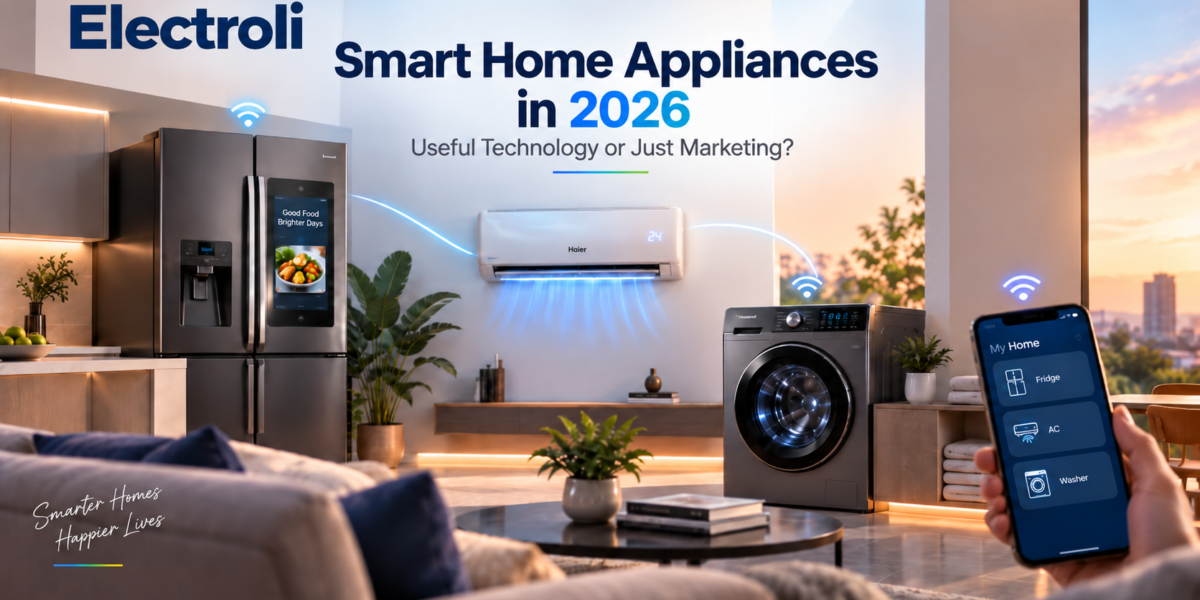
Imagine coming home on a hot day. Your AC has already started adjusting the room temperature. Your refrigerator knows some of the food stored inside. Your washing machine can analyze a load and recommend or adjust its cycle. And you can check compatible appliances from your phone.
In 2026, manufacturers are increasingly combining Wi-Fi, sensors, apps, cameras, voice assistants and AI to make home appliances more connected and adaptive.
But do you really need your refrigerator connected to Wi-Fi? Does an app make your washing machine better? And when an appliance says “AI Powered”, does that translate into something genuinely useful—or simply another reason to charge more?
That’s what Pakistani buyers should understand before paying for the word smart.
Quick Answer: Are Smart Appliances Actually Useful?
Yes—but only when the smart feature solves a real problem.
• Reduce repetitive work
• Improve convenience
• Help monitor energy use
• Automatically adapt appliance operation
• Provide meaningful remote control
• Detect useful conditions
• Help with maintenance
• Connect appliances in a useful way
A smart feature becomes much less valuable when it simply adds another screen, another app you rarely open, duplicates a physical button, requires unnecessary accounts, adds features unavailable in your country, or raises the price without improving the appliance’s core performance.
Better question: “What useful thing does this appliance do because it is smart?”
First: What Makes an Appliance “Smart”?
At the simplest level, a smart appliance may connect to your home network and allow you to interact with it through an app.
Traditional Appliance: User → Appliance
Connected Smart Appliance: User → Smartphone App → Appliance
Newer appliances increasingly move toward: User + Sensors + AI → Appliance → Automatic Adjustment
A Wi-Fi washing machine and an AI washing machine aren’t necessarily the same thing
Smart vs AI Appliances: What’s the Difference?
| Smart Appliance | AI Appliance |
| Connects to an app | Can analyze information |
| Remote monitoring | Can interpret sensor data |
| Sends notifications | Can adapt certain behavior |
| Remote control | May learn usage patterns |
| Scheduled routines | Can automate some decisions |
| Usually follows commands | May proactively recommend actions |
A product can be smart without sophisticated AI. Likewise, modern AI appliances usually rely on smart connectivity to unlock their broader ecosystems.
The Smart Home Is Changing in 2026
The original smart-home dream was mostly about controlling everything from your phone. In 2026, the industry is increasingly focusing on appliances understanding context instead of waiting for every command.
The trend is moving beyond more Wi-Fi appliances toward more connected, automated and energy-aware homes.
Smart Refrigerators: Useful or Overkill
The smart refrigerator is perhaps the perfect example of the debate. Its most important job remains keeping food at the correct temperature, but newer premium refrigerators are attempting to solve another problem: managing the food inside them.
Useful Feature: Seeing What’s Inside
Some connected refrigerators can provide remote information about what is inside. This can be useful when shopping and you cannot remember whether an item is already at home.
Useful Feature: AI Food Recognition
Selected premium refrigerators use cameras and AI vision to recognize supported food items and assist with inventory, use-by-date management and recipe suggestions.
The idea is: Camera → Recognizes supported food → Inventory information → Food management. Recognition has limitations, and supported foods and features can vary.
Useful Feature: “What Can I Cook?”
Selected connected refrigerators can use food information to recommend recipes. In compatible ecosystems, a selected recipe may also connect with supported cooking appliances.
That is more meaningful than simply placing a large display on a refrigerator door.
Marketing Risk: The Giant Screen
A large touchscreen can look futuristic in a showroom, but buyers should ask whether they will still use it six months later.
• Reliable cooling
• Suitable capacity
• Good storage layout
• Energy efficiency
• Reliable compressor
• Warranty
• Local service support
A screen should come after those fundamentals.
2. Smart Air Conditioners: One of the More Practical Categories
For Pakistani consumers, smart AC technology can potentially be especially useful because AC usage directly affects comfort and electricity consumption.
Useful Feature: Remote Cooling
A connected AC may allow you to start cooling remotely before arriving home. This is simple technology, but simple does not mean useless.
Useful Feature: Adaptive Cooling
AI-enabled ACs can go beyond remote control. Selected systems can analyze factors such as temperature, humidity, usage behavior, room conditions, presence and preferred comfort, then adapt operation.
This is where “smart” becomes genuinely interesting: the appliance is not simply connected; it is adaptive.
Useful Feature: Energy Monitoring
Energy monitoring could become one of the more valuable smart-home functions in Pakistan. Connected systems can potentially provide greater visibility into appliance usage.
The long-term idea is: Measure → Understand → Automate → Reduce Waste.
However, monitoring electricity does not automatically reduce consumption. Efficient hardware and sensible usage still matter.
3. Smart Washing Machines: More Useful Than They Sound?
Laundry involves load size, fabric, soil level, detergent, water and cycle duration. Newer intelligent machines try to automate more of these decisions.
Useful Feature: Load Detection
Selected AI washing machines can detect information about a laundry load and adjust operation accordingly, reducing the amount of guessing required from the user.
Useful Feature: Learning Your Laundry Routine
Some smart machines can prioritize frequently used cycles or adapt the interface according to usage. It is not revolutionary, but it can reduce repetitive setup.
Smart technology often works best when it is not impressive once, but useful repeatedly.
Useful Feature: Maintenance Alerts
Connected appliance platforms can potentially detect abnormalities, send maintenance reminders, notify users about required care and help diagnose certain problems.
Over the lifetime of an appliance, this may be more useful than a flashy touchscreen.
4. Smart TVs: Already Normal
Televisions demonstrate what happens when smart technology becomes mature. Streaming apps, casting, voice features and connected-device control have become normal parts of TV usage.
A similar transition may eventually happen with other appliances: today’s premium connected feature can become tomorrow’s standard feature.
5. Connected Appliances Can Work Together
One smart appliance alone may not transform a home. Several compatible devices can create more useful automation.
Example: Phone detects you’re heading home → AC prepares room → Lights adjust → Connected appliances report status → Energy dashboard shows usage.
This is where ecosystem compatibility becomes important.
The Big Problem: Ecosystem Lock-In
If a refrigerator, AC, washing machine and smart lights all require separate apps and accounts, a smart home can quickly become four apps, four accounts and four ecosystems.
Interoperability standards such as Matter are intended to improve communication across compatible smart-home products and ecosystems.
Before buying a smart appliance, ask: What ecosystem does this work with?
Smart Appliances and Energy: Genuine Benefit or Marketing?
Smart technology can help manage energy, but smart technology does not automatically mean energy-efficient hardware.
Buyers should separate Energy Monitoring from Energy Efficiency.
Best combination: Efficient Appliance + Useful Energy Monitoring + Smart Automation
Does AI Energy Mode Guarantee a Lower Electricity Bill?
No. AI-based energy modes can modify appliance operation to reduce consumption under particular conditions, but results depend on the model, usage behavior, environment, settings, selected mode and test conditions.
Manufacturer percentages should be understood as results under specified conditions—not guaranteed reductions on every Pakistani electricity bill.
The Software Update Advantage
A connected appliance may receive software improvements after purchase. That introduces a new buying consideration: software support period.
For a refrigerator or washing machine expected to last many years, long-term software and security support increasingly matters.
But Software Can Also Become a Weakness
• Apps
• Servers
• Accounts
• Software
• Wi-Fi
• Cloud services
• Security updates
The appliance’s essential function should still work reliably. A refrigerator should remain a good refrigerator even if its app is unavailable.
What About Privacy?
As appliances gain cameras, microphones, presence sensors, usage history, household routines and connected accounts, privacy and security become part of the buying decision.
• What information does the appliance collect?
• Does it use cameras or microphones?
• Can those sensors be disabled?
• Is information processed locally or in the cloud?
• Does it require an account?
• How long will security updates continue?
• Can I delete my data?
• Will core features work without internet access?
Smart convenience should not mean ignoring digital security.
Smart Home Appliance: Useful vs Marketing
| Feature | Potential Value |
| Remote AC control | High for some households |
| Energy monitoring | Potentially useful |
| Automatic laundry adjustment | Useful |
| Maintenance alerts | Useful |
| Food management | Useful for some households |
| Remote appliance status | Convenient |
| Cross-device automation | Useful with compatible ecosystem |
| Giant appliance touchscreen | Depends heavily on usage |
| Voice control | Convenience dependent |
| AI label without clear function | Low information value |
| App replacing a simple physical button | Limited value by itself |
The 30-Day Test
Before paying extra for a smart feature, ask: “Will I use this at least once during a normal 30-day period?”
• Remote AC control? Probably, for some households.
• Washing-machine maintenance alert? Likely useful when needed.
• Energy monitoring? Potentially regularly.
• Recipe suggestions from refrigerator? Depends on your household.
• Watching videos on your refrigerator? Maybe not.
This simple question can separate practical technology from showroom excitement.
Are Smart Appliances Worth It in Pakistan?
They can be—but the decision needs to be particularly practical.
Electricity Costs
Energy management and efficient operation can matter significantly.
Internet Reliability
Determine which features continue working without internet access.
Local App Support
An international feature is not necessarily supported locally.
Service Network
Advanced electronics require dependable after-sales support.
Warranty
Check whether smart components, screens and electronics are covered.
Price Premium
Calculate how much more you are paying for smart functionality.
Local Feature Availability
Do not buy based solely on a foreign review. Check the exact Pakistani model number.
When a Smart Appliance IS Worth Paying More For
• Saves you repetitive effort through useful automation.
• Gives useful energy information you can act on.
• Improves appliance operation through meaningful sensing.
• Helps with maintenance and care.
• Integrates with devices you already own.
• Has reliable software and security support.
When You Probably Shouldn’t Pay Extra
• You are buying mainly because the appliance says AI.
• The smart model costs significantly more but performs the same core job.
• The feature is not supported in Pakistan.
• You do not plan to connect the appliance to Wi-Fi.
• You dislike using apps for household appliances.
• The basic model has better efficiency or specifications.
• You are sacrificing capacity, reliability or warranty to afford smart features.
Core Performance Still Comes First
| Category | Priority |
| Refrigerator | Cooling first. AI second |
| Air Conditioner | Cooling efficiency first. App second |
| Washing Machine | Washing performance first. Wi-Fi second |
| Television | Picture quality first. AI features second |
Smart Appliance Buying Priority
CORE PERFORMANCE → ENERGY EFFICIENCY → CAPACITY / SIZE → RELIABILITY → WARRANTY & LOCAL SERVICE → SMART FEATURES → AI FEATURES → ECOSYSTEM COMPATIBILITY → PRIVACY & SOFTWARE SUPPORT → PRICE PREMIUM
7 Questions to Ask Before Buying a Smart Appliance
1. What exactly makes this appliance smart?
Ask for a specific function—not a marketing term.
2. Will I actually use that feature?
Think about your daily routine.
3. Does it work without Wi-Fi?
Especially its core functions.
4. Is the feature supported in Pakistan?
Check the exact model.
5. What app or ecosystem does it require?
Avoid unnecessary fragmentation.
6. How long will software and security updates continue?
This matters for long-life appliances.
7. How much extra am I paying for smart features?
Then decide whether those features justify the premium.
So, Useful Technology or Just Marketing?
Both exist. Some smart-appliance features are genuinely practical: remote AC control, energy monitoring, AI laundry sensing, food management, maintenance alerts and cross-device automation can all add value in the right household.
But putting AI, Smart or Connected on the box does not automatically make an appliance worth buying.
The useful smart home isn’t the one with the most apps. It’s the one where technology quietly removes work.
If you stop noticing the technology because it simply makes everyday life easier, it is probably doing its job.
AEO FAQs
1. Are smart home appliances worth buying in 2026?
Smart appliances can be worth buying when features such as remote control, energy monitoring, automatic adjustments, maintenance alerts or connected automation solve a real household need. Buyers should prioritize core appliance performance, efficiency, reliability and warranty before smart features.
2. What is the difference between a smart appliance and an AI appliance?
A smart appliance typically connects to a network or app for monitoring, control and automation. An AI appliance may additionally analyze sensor data, recognize patterns or adapt certain functions based on conditions and usage.
3. Do smart appliances save electricity?
Smart appliances can help monitor and manage energy consumption, but connectivity alone does not make an appliance energy efficient. Actual electricity use depends on the appliance’s efficiency, settings, environment and usage.
4. Do smart appliances work without Wi-Fi?
Core functions of many smart appliances can continue without Wi-Fi, but features such as remote control, cloud services, software updates and cross-device automation may require connectivity. Buyers should check the exact model.
5. Are smart appliances available in Pakistan?
Yes, connected and smart features are available on selected appliances in Pakistan. However, specific AI and cloud-based features can vary by model and region, so buyers should verify the exact Pakistani model and locally supported functions before purchasing.
Final Thoughts
Smart appliances in 2026 are becoming much more than appliances controlled through a phone. The industry is moving toward appliances that can Sense → Understand → Adapt → Connect → Automate.
That can create real value, but the best smart appliance is not necessarily the appliance with the most technology. It is the one where the technology makes the core appliance better or easier to live with.
Performance → Efficiency → Reliability → Warranty → Useful Smart Features
Choose the appliance first. Then decide whether its intelligence is actually worth paying for.
Looking for Smarter Electronics for Your Home?
Compare available refrigerators, air conditioners, washing machines, TVs and other electronics on Electroli based on the features that matter to your household.



 Account
 Categories

 Search
 Top