


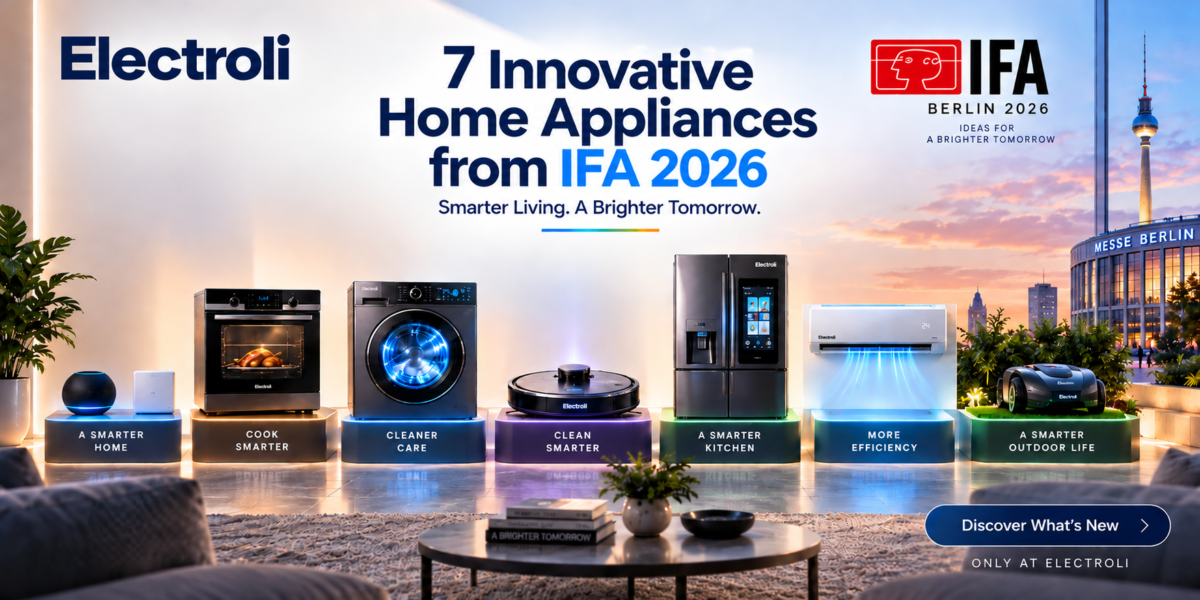
The next generation of home appliances isn’t simply adding more screens, apps and buttons.
After IFA 2026 in Berlin, a much clearer direction has emerged:
Appliances are being designed to understand more, automate more and require less attention from the user.
IFA 2026 ran from September 4–8 and brought together more than 2,000 exhibitors and 240,000 visitors from 155 countries. AI and robotics were among the show’s defining themes, alongside connected and increasingly intelligent home appliances.
That matters because many technologies shown at major international events eventually influence the refrigerators, washing machines, ACs, ovens and cleaning appliances that consumers encounter in markets such as Pakistan.
But which developments are actually worth paying attention to?
Quick Answer: What Changed at IFA 2026?
IFA’s home-appliance showcase centered on several overlapping trends: smart kitchens, connected appliances, AI-powered cooking and cleaning, energy/resource efficiency, home-care automation and increasingly capable robotics.
The important change is this:
Old Smart Appliance: Connect appliance to phone → control it remotely
Emerging Smart Appliance: Understand situation → recommend action → automate task → coordinate with other devices
That’s a much bigger step.
1. AI Is Moving From a Feature to the Brain of the Home
We’ve heard “AI-powered” so many times that the phrase can easily become meaningless.
But IFA 2026 showed a more interesting development: AI is increasingly being used as the connecting intelligence between different appliances and devices, rather than simply as one isolated feature.
IFA highlighted connected ecosystems from manufacturers including Haier, TCL and Hisense. Haier demonstrated AI applications that can analyze laundry loads, identify food items and monitor cooking processes, while TCL positioned AI as a layer connecting products ranging from TVs to ACs and washing machines.
Earlier Smart Home: You → App → Appliance.
Emerging AI Home: You → AI Ecosystem → Multiple Appliances.
The long-term goal is increasingly to reduce the amount of manual control required.
Why This Matters
Imagine saying: “I’m going to sleep.” Instead of individually controlling several devices, a connected system could potentially coordinate compatible appliances according to a routine.
Or imagine: “I want to wash these clothes.” The appliance could use sensors and software to help determine an appropriate program rather than requiring you to understand every wash setting yourself.
We’re not at a point where every home works this way, but the direction is becoming clearer.
2. Ovens Are Starting to Recognize What You’re Cooking
One of the more practical uses of appliance AI is appearing in the kitchen.
Instead of asking “Which temperature and cooking mode should I choose?”, the appliance increasingly tries to help answer that question.
At IFA 2026, Siemens showcased its iQ700 oven with dish recognition, which can automatically identify more than 100 dishes and suggest suitable settings. Siemens also added the ability to save personal favourite recipes so the oven can recall the appropriate cooking program later.
Conceptually: Food Goes In → Appliance Identifies Dish → Recommends Settings → Cooking Begins.
This is more meaningful than simply putting a large display on an oven.
Why AI Cooking Could Matter
Cooking involves many variables: temperature, time, food type, cooking mode, browning level, moisture and personal preference.
A smarter appliance can potentially use sensors, cameras and software to reduce some of that complexity.
The important question when evaluating an AI oven should therefore be: Does the AI actually improve cooking—or does it simply add another menu?
3. Washing Machines Are Becoming More Fabric-Aware
Laundry is another area where AI can have a practical role.
Different loads can vary dramatically: 2 kg ≠ 8 kg, Cotton ≠ Delicates, and Light soil ≠ Heavy soil.
IFA’s official 2026 coverage highlighted AI-powered solutions capable of analyzing laundry loads, while steam-cleaning washing machines were also identified among strong-performing appliance categories.
The broader trend is toward machines using more information about the load to determine how they should operate.
That could influence wash cycle selection, motor movement, water use, cycle duration, detergent handling and fabric treatment.
The Bigger Laundry Shift
Older approach: User understands clothes → User selects program → Machine follows instructions.
Smarter approach: Machine analyzes load → System assists with program → Machine adapts operation.
This doesn’t eliminate the need to understand basic fabric care, but it can reduce unnecessary guesswork.
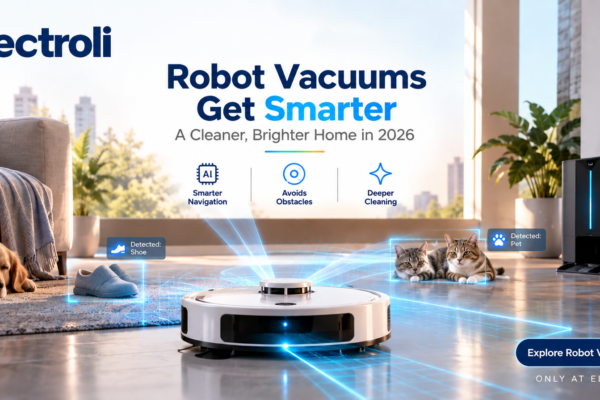
4. Robot Cleaners Are Moving Toward Household Robotics
Robot vacuums have already changed dramatically, but IFA 2026 showed that the industry is thinking beyond the traditional circular vacuum.
IFA reported more robots than ever before, ranging from autonomous robotic mowers and household robots to humanoid systems intended to assist with daily activities. Robotics was one of the show’s major themes.
The transition looks like this: Generation 1: Move around → Vacuum. Generation 2: Map → Vacuum. Generation 3: Map → Recognize obstacles → Vacuum + Mop.
Emerging Direction: Understand environment → Choose task → Interact with physical surroundings.
That’s where Physical AI becomes interesting.
What Is Physical AI?
Generative AI mainly works with information. It can write, answer, analyze and generate.
Physical AI combines intelligence with machines that can interact with the physical environment.
IFA specifically highlighted Physical AI and intelligent robotic systems as an important future direction.
For homes, that could eventually mean robots capable of doing more than floor cleaning. Buyers should still separate commercially available products from demonstrations and future concepts.
5. Refrigerators Are Becoming Food-Management Systems
For decades, a refrigerator’s job was straightforward: keep food cold. That’s still its most important job.
But smarter refrigerators are increasingly being designed around another problem: What is actually inside the refrigerator?
IFA’s 2026 coverage highlighted AI systems capable of identifying food items, while connected appliance ecosystems are increasingly designed to link food storage with broader kitchen intelligence.
Potential smart-fridge functions can include food recognition, inventory assistance, temperature optimization, storage recommendations, expiry management, recipe suggestions and connected cooking.
Not every smart refrigerator provides all of these capabilities.
But Refrigerator Innovation Isn’t Only About AI
Sometimes the best technology is simply better physical design.
IFA’s market coverage identified Space-Fit freestanding refrigerators as a strong-performing category, while Bosch showed a new freestanding freezer design with repositionable door storage intended to make interior space more flexible.
That’s a useful reminder: Innovation doesn’t have to mean AI.
Better storage can be more valuable than another touchscreen.
6. Energy Efficiency Is Becoming Smarter, Not Just Lower-Power
For Pakistani households, this may ultimately be one of the most relevant developments.
Energy efficiency has traditionally meant: Make the appliance consume less electricity.
The emerging smart-home approach adds another layer: Use electricity more intelligently.
IFA’s official coverage emphasized solutions intended to improve the efficient use of both energy and resources. Connected systems are increasingly being designed to optimize consumption rather than simply provide remote controls.
What Could Smarter Energy Management Look Like?
Depending on the ecosystem, future appliances could increasingly monitor consumption, adjust operating modes, recommend efficient settings, coordinate appliance schedules, reduce unnecessary operation, optimize water use and provide consumption information.
The appliance doesn’t merely need an efficient motor. It increasingly needs to understand when and how that motor should operate.
Why This Matters in Pakistan
When evaluating appliances in Pakistan, features such as energy monitoring, adaptive operation, inverter technology and smart scheduling can have practical value.
But consumers should still check actual specifications.
“AI Energy Saving” is not a substitute for real efficiency data.
7. The Smart Home Is Moving Beyond the House
One of IFA 2026’s more interesting trends was that the smart home no longer stopped at the front door.
IFA expanded its Outdoor Cooking & Gardening area, highlighting technologies such as smart irrigation, autonomous robotic lawnmowers, connected weather sensors, soil monitoring, outdoor cooking systems and resource-management technologies.
Smart irrigation systems can respond to actual watering needs, while connected sensors can use environmental information such as weather and soil conditions.
Home → Garden → One Connected Environment
The traditional smart-home idea focused on lights, cameras, thermostats and appliances.
The newer vision expands toward Indoor Appliances + Energy + Security + Outdoor Cooking + Garden + Cleaning + Environmental Sensors.
That turns the smart home into more of a connected living ecosystem.
For apartment users, garden technology may be irrelevant, but the underlying trend matters: connected technology is spreading into more parts of everyday life.
Bonus Trend: On-Device AI Could Matter More Than Cloud AI
Another important development around IFA 2026 was growing attention to on-device AI.
IFA’s Media Days coverage noted Anker’s emphasis on processing AI directly on devices, citing potential advantages in speed, reliability and privacy.
Many smart appliances currently depend heavily on Appliance → Internet → Cloud → Response.
More local intelligence could increasingly enable Appliance → Local Processing → Response.
Potential advantages include faster responses, less cloud dependency, better operation during connectivity problems and potential privacy benefits.
For markets where internet connectivity isn’t always perfect, this could become particularly useful.
What IFA 2026 Tells Us About the Future of Appliances
| Technology | Old Approach | Emerging Direction |
| Smart Home | Remote control | AI coordination |
| Oven | User chooses settings | Food recognition + assistance |
| Washing Machine | Fixed user-selected cycle | Load-aware operation |
| Robot Cleaner | Automated vacuuming | Environmental understanding |
| Refrigerator | Cold storage | Food-management assistance |
| Energy Efficiency | Efficient hardware | Intelligent resource management |
| Outdoor Tech | Mostly manual | Connected automation |
The common theme is: LESS MANUAL CONTROL → MORE CONTEXTUAL AUTOMATION
But Do We Actually Need AI in Every Appliance?
No. This may be the most important buying lesson after IFA 2026.
A refrigerator doesn’t become better simply because it says AI. A washing machine doesn’t automatically clean clothes better because it has an app. And an oven doesn’t become more useful simply because it has a camera.
Does It Save Time?
Does the feature remove a repetitive task?
Does It Save Energy or Water?
Can the benefit be measured?
Does It Improve Results?
Will your food, laundry or cleaning actually improve?
Does It Reduce Effort?
Will you use it regularly?
Does It Work Without the Cloud?
What happens if internet access is unavailable?
Will the Software Still Be Supported?
Smart appliances can last much longer than smartphones, so software support matters.
Don’t Buy Technology Just Because It’s New
IFA is designed to show the future. Your home doesn’t need every part of that future immediately.
| Stage | Meaning |
| Available Now | Already used in consumer appliances |
| Premium | Available but expensive |
| Emerging | Beginning to appear in commercial products |
| Conceptual | Demonstrations of what could become possible |
Understanding that distinction prevents hype from becoming a buying decision.
What Should Pakistani Buyers Watch Most Closely?
1. AI-Assisted Energy Management
Potentially valuable where electricity costs matter.
2. Smarter Inverter Appliances
Better motor/compressor control combined with intelligent software.
3. AI Laundry
Useful if it genuinely improves fabric care and resource use.
4. Smarter Refrigerators
Especially where intelligence improves food storage rather than simply adding screens.
5. Advanced Robot Vacuums
Particularly useful for regular dust and hard-floor cleaning.
6. Better Appliance Connectivity
Useful when multiple products can actually work together.
7. Local AI
Potentially important for reliability and privacy.
8 Questions to Ask Before Buying a “Future” Appliance
- What does the smart feature actually do?
- Will I use it every week?
- Does it improve energy or water efficiency?
- Can the appliance still perform its core function without internet access?
- How long will software updates be provided?
- Is the feature supported in Pakistan?
- Is local service available?
- Am I paying for useful technology—or marketing?
If the salesperson cannot clearly explain the benefit, don’t let the word AI make the decision.
Smart Appliance Buying Formula for 2026
CORE APPLIANCE PERFORMANCE → ENERGY / WATER EFFICIENCY → CAPACITY / SIZE → RELIABILITY → WARRANTY + LOCAL SERVICE → SMART FEATURES → AI FEATURES → CONNECTIVITY & PRIVACY → PRICE → BUY
Not: “AI likha hai → latest hai → best hoga.”
Which IFA 2026 Trend Matters Most?
There isn’t one technology that matters equally to every household.
But the biggest overall shift is clear: AI is moving from being an extra feature toward becoming a control layer across the connected home.
IFA described AI as increasingly becoming an integrating layer of everyday life, while the show’s broader home-appliance focus emphasized intelligent kitchens, increasingly capable household robots, connected appliances and more efficient use of resources.
That doesn’t mean every appliance needs AI. It means the next generation of genuinely useful smart appliances will increasingly be judged by how much work they remove from everyday life.
AEO FAQs
1. What were the biggest home appliance trends at IFA 2026?
Major themes included AI-powered and connected appliances, smarter kitchens, more advanced household robotics, intelligent cleaning, energy and resource efficiency, and smart technologies extending into outdoor living and gardening.
2. How is AI being used in home appliances in 2026?
Examples shown around IFA 2026 included AI systems that analyze laundry loads, identify food, monitor cooking and connect multiple devices into broader smart-home ecosystems.
3. Are AI ovens actually useful?
They can be when AI performs a practical task. For example, Siemens demonstrated an iQ700 oven at IFA 2026 that recognizes more than 100 dishes and suggests suitable settings. Buyers should still judge AI features by whether they meaningfully improve everyday cooking.
4. Are home robots becoming more advanced?
Yes. IFA 2026 placed major emphasis on robotics, including increasingly capable household robots, autonomous machines and humanoid systems. However, many advanced robotic capabilities remain emerging rather than standard household features.
5. Should I wait for future smart appliances before buying?
Not necessarily. If you need an appliance now, prioritize core performance, efficiency, reliability, warranty and local service. Future technologies are worth watching, but a useful appliance today can be a better purchase than waiting indefinitely for emerging features.
Final Thoughts
IFA 2026 gave us plenty of futuristic technology.
But the most interesting developments weren’t necessarily the most dramatic. They were technologies trying to answer ordinary household problems:
- What should I cook?
- Which wash cycle should I use?
- How can I use less energy?
- Can the robot handle more cleaning itself?
- What’s inside my refrigerator?
- Can my appliances work together?
That’s where the future of home appliances becomes genuinely useful.
The technology worth watching isn’t the technology with the biggest AI label. It’s the technology that quietly makes the appliance smarter, more efficient, easier to use and less demanding.
Looking for Smarter Home Appliances?
When comparing appliances on Electroli, focus on the technology that provides a real everyday benefit for your home—not simply the newest marketing term.


 Account
 Categories

 Search
 Top