


For years, the idea of a “smart kitchen” mostly meant putting Wi-Fi into an appliance.
Connect your oven to an app. Check your refrigerator from your phone. Start an appliance remotely.
Useful? Sometimes. Revolutionary? Not really.
But in 2026, the idea is becoming much more interesting.
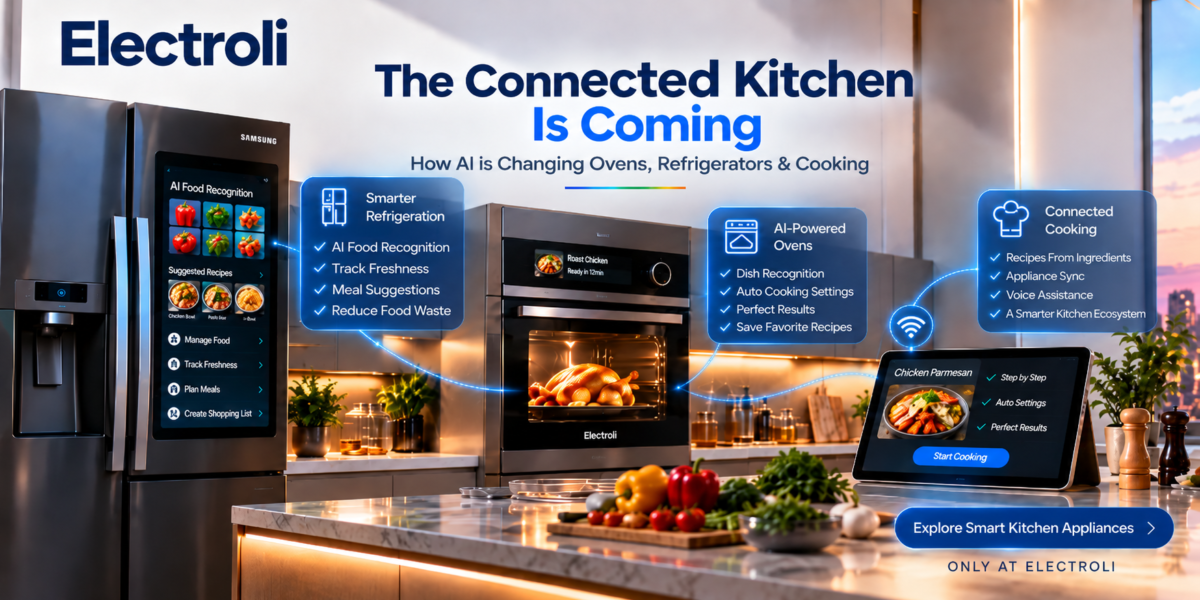
The next generation of kitchen appliances is increasingly being designed to recognize food, understand cooking situations, recommend settings, manage ingredients and work together as part of a connected ecosystem.
At IFA 2026, smart kitchens and connected appliances were major themes. The event highlighted AI-powered cooking systems and kitchen technology designed to reduce the number of programs and settings users have to manage manually.
The kitchen is gradually moving from Connected Appliances toward Connected Intelligence. And that could change how we think about cooking.
Quick Answer: What Is an AI Connected Kitchen?
An AI connected kitchen is a kitchen where compatible appliances use sensors, software, connectivity and artificial intelligence to assist with everyday tasks.
Instead of each appliance operating completely independently, the broader idea is that refrigerators, ovens and other kitchen devices can increasingly understand information and use it to help the user make decisions.
| Traditional Kitchen | Smart Kitchen | AI Connected Kitchen |
| Manual controls | App control | Context-aware assistance |
| User checks food | App provides information | AI can recognize selected foods |
| User chooses oven settings | Remote oven controls | AI can suggest cooking settings |
| Refrigerator stores food | Connected refrigerator | Food-management assistance |
| Recipe selected manually | Recipe app | Personalized cooking guidance |
| Appliances work alone | Appliances connect to phone | Ecosystem connects appliances |
| Fixed functionality | Software features | Features can evolve through updates |
The most important change is not: “Can I control my refrigerator from my phone?” It’s: “Can my kitchen help me decide what to do next?”
1. Refrigerators Are Starting to Understand What’s Inside
The refrigerator may become the information center of the connected kitchen.
Traditionally, its job has been simple: keep food at the correct temperature. That’s still the most important function.
But AI-enabled refrigerators are increasingly trying to solve another everyday problem: What’s actually inside my fridge?
Samsung’s 2026 Bespoke AI refrigerator updates provide a real example. Its AI Vision system uses vision-based AI to improve food recognition, and Samsung says its upgraded system built with Google Gemini expands the range of items it can recognize.
This turns the refrigerator from passive storage into something closer to a food-information system.
2. Food Recognition Could Change Meal Planning
Imagine opening your refrigerator and not having to mentally remember everything inside.
A sufficiently capable smart refrigerator could help maintain information about available ingredients.
That creates a possible flow: Food Recognition → Ingredient Information → Meal Suggestions → Recipe Selection → Cooking Guidance.
The benefit isn’t simply “My fridge has a camera.” The useful outcome is: “My fridge can help me understand what food I have.”
3. The Refrigerator Could Help Answer “What Should I Cook?”
This might eventually become one of the most useful connected-kitchen experiences.
We’ve all had the same situation: you open the refrigerator, look inside, close it, then ask: “Aaj kya banayein?”
A smarter kitchen can potentially combine food information with recipe and meal-planning tools.
The basic logic becomes: What food is available? → What can be prepared from it? → Which recipe suits the user? → How should it be cooked?
That is where the connected refrigerator becomes more interesting than a refrigerator with a large screen.
4. AI Ovens Are Learning to Recognize Food
The oven is changing too.
Traditional cooking requires the user to determine cooking mode, temperature, cooking time, rack position, preheating and browning preference.
At IFA 2026, Siemens showcased a new oven capable of automatically recognizing more than 100 dishes and suggesting appropriate settings. It can also save favorite recipes for later use.
The workflow starts looking like: Put Food In → Oven Recognizes Dish → System Recommends Settings → Cooking Begins → Sensors Monitor Progress.
That’s a much more meaningful application of AI than simply adding another touchscreen.
5. The Oven Is Becoming a Cooking Assistant
One of the most interesting trends is the move from Cooking Appliance to Cooking Assistant.
Miele’s IFA 2026 showcase, for example, included an AI-powered CulinaryCoach and connected cooking functions designed to help with everyday decisions.
That could make advanced cooking more approachable for people who don’t know exactly which combination of temperature, time and mode to use.
The oven doesn’t necessarily replace the cook. It reduces some of the technical decision-making around cooking.
6. Sensors May Matter as Much as AI
It’s easy to focus on the word AI, but an intelligent appliance needs information before it can make a useful decision.
Depending on the appliance, modern cooking systems may use cameras, temperature sensors, humidity sensors, food probes, weight/load detection, door sensors and cooking history.
Think of it this way: SENSORS = Eyes & Ears; AI / SOFTWARE = Brain; APPLIANCE = Hands.
Without useful data, AI has very little to work with.
7. The Bigger Change Is Appliances Talking to Each Other
This is where the idea of the connected kitchen becomes different from simply owning several smart appliances.
Imagine this workflow: Refrigerator recognizes available ingredients → Kitchen AI suggests possible meals → User selects a recipe → Oven receives compatible cooking information → Cooking system recommends or adjusts settings → App tracks progress and sends an alert.
Instead of five smart appliances, you begin to have one connected kitchen system.
The desired outcome is less focus on complicated programs and more focus on successful cooking results.
8. Voice AI Could Become More Useful in the Kitchen
Voice control has existed for years, but basic commands such as “Set timer for 10 minutes” aren’t particularly revolutionary.
The more interesting future is conversational assistance: “What can I cook with chicken, tomatoes and rice?”, “How long should I cook this?”, or “What ingredients am I missing?”
The combination matters more than either feature alone: Vision + Food Data + AI + Voice.
9. AI Could Help Reduce Food Waste
Food waste often happens for a simple reason: we forget what we already have.
Food gets pushed behind other items, an ingredient is forgotten, another one is purchased unnecessarily, or something expires.
Better food tracking could potentially help households become more aware of what’s available.
A connected food-management system could assist with ingredient tracking, meal planning, shopping decisions, expiration reminders, leftover awareness and recipe recommendations.
This doesn’t mean AI automatically eliminates food waste, but better information can make avoiding unnecessary waste easier.
10. Smart Kitchens Could Become More Personalized
Two households don’t cook the same way.
One family may prefer Pakistani food. Another may cook mostly quick meals. Someone may bake frequently. Another person may barely use the oven.
Connected kitchen systems can potentially become more useful as they learn or store preferences.
That could influence favorite recipes, preferred cooking levels, frequently used programs, meal suggestions, appliance routines and dietary preferences.
11. Your Appliances May Improve After You Buy Them
This is a major change in appliance thinking.
Traditional appliance: Features on Day 1 = Features years later.
Software-driven appliance: Hardware + Software Updates = Features Can Evolve.
Samsung demonstrated this in 2026 by rolling out AI-focused software updates to selected existing refrigerators rather than limiting every new capability to newly purchased hardware.
That creates an important new buying question: How long will this appliance receive software support?
A refrigerator might last considerably longer than the average phone, so software longevity matters.
12. But Connected Kitchens Create New Questions About Privacy
More intelligence usually requires more data.
A kitchen with cameras, microphones, food recognition and connected accounts raises reasonable questions.
Buyers should ask what data is collected, where it is processed, whether camera footage is stored, whether features can work locally, which features require cloud access, whether microphones or cameras can be disabled, and how long security updates will continue.
Smart should also mean secure and understandable.
13. What Happens When the Internet Goes Down?
This is particularly relevant when considering smart appliances for Pakistan.
The refrigerator still needs to refrigerate. The oven still needs to cook. The appliance’s core function should not depend entirely on an internet connection.
Before buying a connected kitchen appliance, ask: What works offline?
There is a big difference between Internet adds optional intelligence and Internet is required for important functionality.
14. Connected Doesn’t Automatically Mean Better
A smart appliance can still be a bad appliance.
An oven with excellent AI but poor temperature consistency isn’t a great oven. A refrigerator with a giant screen but weak cooling performance isn’t a great refrigerator.
A smart appliance should first succeed at its core job.
For a refrigerator: Cooling → Efficiency → Capacity → Reliability → Smart Features.
For an oven: Cooking Performance → Temperature Control → Capacity → Safety → Smart Features.
AI should improve the appliance. It shouldn’t distract from basic performance.
Smart Kitchen Technology: Useful vs Marketing
| Feature | Potential Practical Value |
| Food recognition | High if accurate |
| Ingredient tracking | Useful |
| Recipe recommendations | Useful for frequent cooks |
| Automatic oven settings | High |
| Cooking monitoring | High |
| Remote notifications | Useful |
| Energy monitoring | Useful |
| Voice assistant | Depends on user |
| Connected appliance routines | Potentially high |
| Large refrigerator screen | Depends on usage |
| AI branding without clear function | Low |
| Decorative app features | Low |
The important question is always: What problem does this feature solve?
What Could the Connected Kitchen Look Like?
Imagine coming home in the evening. Your refrigerator already knows some of the food stored inside.
You ask: “Dinner mein kya bana sakta hoon?”
The system suggests three meals based on available ingredients. You choose one. The recipe appears. Compatible cooking instructions are sent to the oven. The oven recommends its cooking mode and temperature. You start cooking. The system monitors progress. Your phone alerts you when attention is needed.
That is the connected-kitchen vision: not more screens, but fewer decisions.
What Matters for Pakistani Buyers?
1. Core Appliance Performance
Cooling and cooking come first.
2. Energy Efficiency
Especially important for appliances used daily.
3. Voltage & Local Compatibility
Make sure the appliance is suitable for the local market.
4. Warranty
Smart components can make repairs more complicated.
5. Local Service
Check whether trained support is available.
6. Smart Feature Availability
A feature advertised internationally may not necessarily work identically in Pakistan.
7. App Support
Check regional compatibility before buying.
8. Replacement Parts
Long-term appliance ownership matters.
9. Offline Functionality
Core functions should remain dependable.
10. Actual AI Benefit
Don’t pay extra merely because the product says AI.
8 Questions to Ask Before Buying an AI Kitchen Appliance
- What exactly does the AI do?
- Does it improve cooking, storage or convenience?
- Will the feature work in Pakistan?
- Does it require constant internet access?
- How long will software and security updates continue?
- Can smart features be disabled?
- Is local warranty and service available?
- Would I still choose this appliance without the AI feature?
That final question is especially useful. If the answer is no, you may be buying the technology rather than the appliance.
Connected Kitchen Buying Formula
CORE PERFORMANCE → RELIABILITY → ENERGY EFFICIENCY → CAPACITY / SIZE → WARRANTY + SERVICE → SMART FEATURES → AI BENEFIT → SOFTWARE SUPPORT → PRIVACY + SECURITY → PRICE
AI belongs in the decision. It just shouldn’t be at the top.
Is the Connected Kitchen Really Coming?
Yes—but probably more gradually than futuristic advertisements suggest.
We’re already seeing pieces of it. AI-enabled food recognition exists in commercial refrigerators. AI-assisted ovens can recognize dishes and recommend settings. Connected platforms can link appliances, apps and cooking information. Software updates can add capabilities after purchase.
What is still developing is the seamless connection between all of those pieces.
The long-term direction appears to be: Refrigerator Understands Food → AI Helps Plan Meal → Recipe Connects to Cooking Appliance → Oven Assists With Cooking → Connected System Manages the Experience.
That’s when a collection of smart appliances begins to feel like a genuinely smart kitchen.
AEO FAQs
1. What is an AI connected kitchen?
An AI connected kitchen uses compatible smart appliances, sensors, software and connectivity to assist with tasks such as food management, recipe selection, cooking settings and appliance control. The goal is increasingly to connect information across appliances rather than simply controlling each appliance from an app.
2. What can an AI refrigerator do?
Depending on the model, an AI refrigerator may use cameras and software to recognize supported food items, assist with food management, provide connected features and contribute to meal planning.
3. What does AI do in a smart oven?
AI-enabled ovens can use sensors, cameras and software to assist with food recognition, cooking settings or monitoring. At IFA 2026, Siemens showed an oven that can recognize more than 100 dishes and suggest appropriate settings.
4. Do smart kitchen appliances need internet access?
Some connected and cloud-based features require internet access, while core appliance functions and selected smart features may work locally. This varies by model, so buyers should check exactly what remains available offline.
5. Is an AI kitchen appliance worth buying in Pakistan?
It can be if the appliance already performs its core job well and its smart features provide a benefit you’ll actually use. Pakistani buyers should also verify regional app support, warranty, local service, parts availability, energy efficiency and which AI functions are supported locally.
Final Thoughts
The biggest kitchen innovation in 2026 isn’t another touchscreen. It’s context.
The refrigerator increasingly understands what’s inside. The oven increasingly understands what’s cooking. Software increasingly understands what the user wants to accomplish. And connected platforms are beginning to bring those pieces together.
The best connected kitchen won’t be the one with the most AI. It will be the one where technology quietly helps answer everyday questions:
- What food do I have?
- What can I make?
- How should I cook it?
- When will it be ready?
That’s when a smart kitchen becomes genuinely useful.
Looking for Smarter Kitchen Appliances?
When comparing refrigerators, ovens and other kitchen appliances on Electroli, start with performance, efficiency, reliability and useful technology—not simply the AI label.





 Account
 Categories

 Search
 Top