


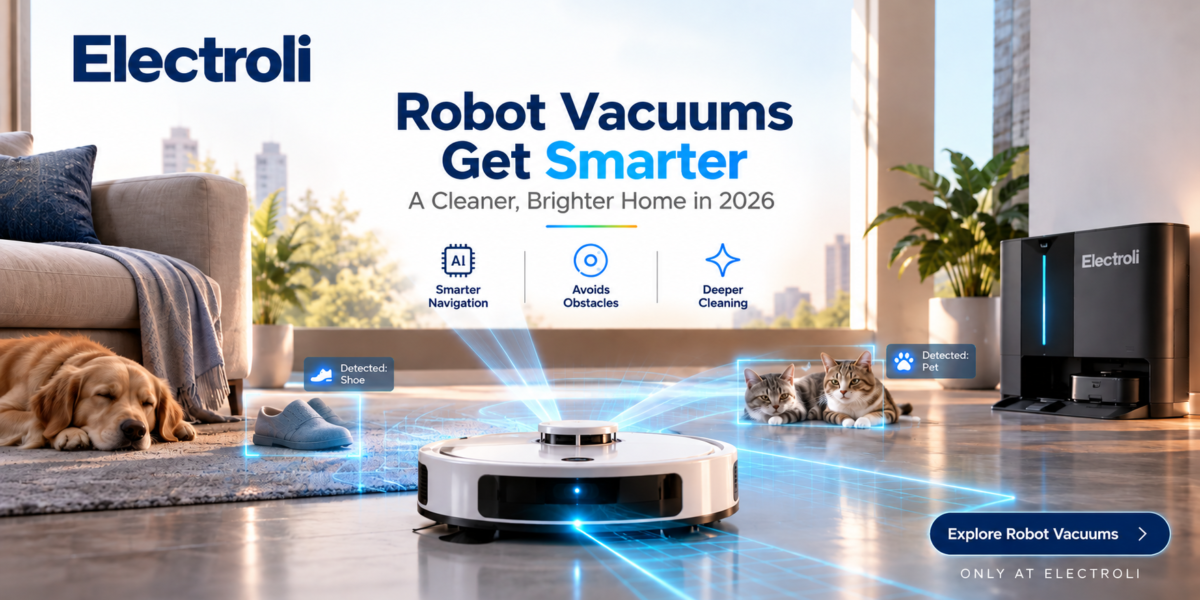
A few years ago, owning a robot vacuum mostly meant watching a small circular machine drive around your floor, occasionally getting trapped under furniture or eating a charging cable.
In 2026, that description feels increasingly outdated.
Robot vacuums are moving from simple automated cleaners toward more capable home-cleaning robots.
Newer systems can combine mapping, AI-powered object recognition, obstacle avoidance, automatic mop washing, dirty-water management, edge cleaning, carpet detection and increasingly sophisticated movement around thresholds and uneven surfaces.
So what actually changed—and which improvements matter to someone buying a robot vacuum for a real home?
Quick Answer: What Changed in Robot Vacuums in 2026?
The biggest change isn’t simply more suction. It’s greater autonomy.
Earlier robot vacuums mainly answered: “Where should I vacuum?”
The newest generation increasingly tries to answer: “What am I looking at, how should I clean it, what should I avoid, and what maintenance can I handle myself?”
| Earlier Robot Vacuums | Newer 2026 Direction |
| Basic navigation | Advanced mapping + AI navigation |
| Avoid walls | Recognize different obstacles |
| Vacuum only | Vacuum + advanced mopping |
| Basic mop pad | Roller/self-washing mop systems |
| User cleans mop | Dock washes and dries it |
| User empties bin | Automatic dust emptying |
| Struggles at edges | Extendable edge-cleaning systems |
| Gets stuck on thresholds | Improved climbing mechanisms |
| Single-floor focus | Stair/multi-level concepts emerging |
| Fixed cleaning routine | More adaptive cleaning |
Not every 2026 robot has all these capabilities. Many advanced features remain limited to premium products or concepts.
1. Robot Vacuums Are Starting to Understand the Room
Navigation used to be one of the biggest weaknesses of robot vacuums. Basic models could move around a room but didn’t necessarily understand it particularly well.
Modern premium robots increasingly combine LiDAR, cameras, structured light, sensors and AI to build and interpret a more detailed picture of the environment.
This can allow compatible models to map rooms, plan routes, identify obstacles and change behavior based on what they encounter.
The important shift is: Navigation → Environmental Understanding.
2. AI Obstacle Recognition Is Becoming Much More Important
One of the most frustrating robot-vacuum experiences is finding that the robot has eaten a charging cable, dragged a sock around, become trapped near furniture or pushed a small object across the floor.
Modern robots increasingly attempt to identify obstacles rather than simply detect that something is physically in the way.
A sophisticated robot may treat a cable as something to avoid, a shoe as an object to navigate around, furniture legs as route constraints and carpet as a surface requiring a different cleaning strategy.
AI obstacle avoidance still isn’t perfect, especially with very small or unusual objects.
3. Mopping Is Becoming Much More Serious
Older robot-vacuum mopping could sometimes feel like attaching a wet cloth and dragging it around the floor.
Manufacturers are now developing rotating mop pads, vibrating systems, roller mops, continuous mop washing, dirty-water collection, increased downward pressure, automatic mop lifting, edge-extending mops and hot-water dock cleaning.
This turns mopping from a secondary add-on into a much more important part of the cleaning system.
4. The Mop Can Now Clean Itself While Working
If you clean an entire house using the same dirty cloth without rinsing it, eventually you’re moving dirty water around rather than cleaning effectively.
Newer systems increasingly refresh the mop during cleaning or return to the dock for washing.
Conceptually: Clean Water → Mop Floor → Remove Dirty Water → Refresh Mop → Continue Cleaning.
That can be a more meaningful improvement than simply adding more app features.
5. Robots Are Getting Better at Understanding Different Messes
The next step is not merely “There is dirt here.” It is “What kind of dirt is here?”
Selected newer cleaning robots use sensors or AI to distinguish between floor conditions or messes and adjust their cleaning approach.
This points toward an important direction: Same Room ≠ Same Cleaning Everywhere.
6. Edge Cleaning Is Finally Getting More Attention
Round robots have an obvious problem: corners aren’t round.
Older robot vacuums could clean open floor areas effectively but struggle near walls, skirting boards, furniture edges and corners.
Newer designs increasingly use extendable side brushes and mop mechanisms that reach beyond the robot’s main body.
This is a less flashy improvement that may matter every day.
7. Robot Vacuums Are Getting Better at Climbing
For years, a slightly awkward threshold could defeat an expensive robot vacuum.
Manufacturers are developing lifting chassis, specialized wheels and climbing systems to help robots cross larger thresholds and floor transitions.
This matters in homes with room thresholds, sliding-door tracks, rugs, slight floor-height differences and mixed surfaces.
For many Pakistani homes, threshold performance could matter more than another large suction number.
8. And Now They’re Going After Stairs
Robot vacuums have historically been single-level machines. They can detect stairs to avoid falling but normally cannot climb them and continue cleaning another floor.
2026 demonstrations show manufacturers actively experimenting with wheel-leg architectures and tracked carrier systems for multi-level mobility.
These technologies remain emerging rather than normal features on mainstream robot vacuums.
So buyers should not assume a premium robot can independently clean staircases today.
9. The Dock Is Becoming Almost as Important as the Robot
Earlier robot vacuum: Robot + Charging Base.
Modern premium system: Robot + Cleaning Station.
The station may handle charging, dust-bin emptying, clean-water storage, dirty-water collection, mop washing, heated washing, mop drying, cleaning-solution dispensing and dock self-cleaning.
The goal is straightforward: reduce how often the owner needs to touch the robot.
10. “Self-Cleaning” Doesn’t Mean Zero Maintenance
A robot may advertise self-emptying, self-washing, self-drying or self-cleaning, but someone still has to maintain the system.
Depending on the model, you’ll eventually need to refill clean water, empty dirty water, replace dust bags, remove trapped hair, clean sensors and brushes, replace filters, clean the dock and replace worn mop components.
A better phrase is lower-maintenance cleaning rather than no-maintenance cleaning.
11. Suction Numbers Are Getting Huge—but Don’t Buy on Pa Alone
Modern robot-vacuum marketing increasingly highlights very large suction figures.
But higher Pa does not automatically mean better cleaning.
Real-world pickup also depends on brush design, airflow, floor type, seal, cleaning path, robot speed, carpet behavior, hair management and software.
A robot with a larger advertised number isn’t automatically the better robot.
12. Hair-Tangle Prevention Is Improving
Anyone with long hair, children or pets knows the problem: hair wraps around the main brush, and then you become the robot vacuum’s cleaner.
Manufacturers increasingly use anti-tangle brush designs, split rollers, comb structures, specialized brush geometry and automatic hair-removal mechanisms.
For real households, this can be more valuable than a flashy AI feature.
13. Robots Are Getting Thinner Too
Smarter isn’t useful if the robot can’t reach the dirt.
A common problem is that a robot is too tall to fit under a sofa, bed or cabinet.
Manufacturers are therefore working on lower-profile navigation systems and retractable sensor designs.
Better access can matter as much as stronger suction.
14. The Robot Is Becoming More Adaptive
The future of robot cleaning isn’t: Press Start → Same Routine Everywhere.
It’s closer to: Understand Room → Understand Surface → Detect Mess → Choose Cleaning Method → Clean → Maintain Itself.
A sophisticated system may increasingly treat a kitchen differently from a bedroom, carpet differently from tile, and a dried stain differently from ordinary dust.
15. AI Is Becoming the Brain, Not Just the Marketing Label
AI is everywhere in appliance marketing, but in robot vacuums there are areas where machine intelligence can have a genuinely useful role.
Examples include obstacle recognition, navigation, cleaning decisions, stain detection and room understanding.
The useful question isn’t “Does this robot have AI?” Ask: “What does AI allow this robot to do that a normal robot cannot?”
Robot Vacuums: Then vs 2026
| Area | Older Generation | 2026 Direction |
| Navigation | Basic/random or early mapping | Advanced LiDAR + sensors + AI |
| Obstacles | Detect collision | Recognize objects |
| Vacuuming | Basic suction | Stronger, more adaptive cleaning |
| Mopping | Wet pad | Roller/rotating/active systems |
| Mop Cleaning | Manual | Automatic/self-washing |
| Edge Cleaning | Limited | Extendable brushes/mops |
| Carpet | Basic detection | Adaptive cleaning/lifting systems |
| Thresholds | Easily stuck | Improved climbing systems |
| Stairs | Avoid only | Experimental climbing systems |
| Dust Bin | Manual emptying | Auto-empty docks |
| Mop Drying | Manual | Automated drying on premium docks |
| Maintenance | Frequent | Increasingly automated |
| Cleaning Logic | Fixed routine | More context-aware |
What Actually Matters for Pakistani Homes?
Hard Floors
Many Pakistani homes use tile, marble or ceramic floors. A strong vacuum-and-mop combination may therefore be particularly useful.
Dust
Dust can accumulate quickly, particularly near main roads, construction, open plots and high-traffic areas. Frequent automated cleaning can be valuable.
Rugs and Carpets
Check carpet detection, mop lifting, suction adjustment and rug-avoidance options.
Thresholds
Measure raised room transitions before buying.
Furniture Clearance
Measure the space beneath beds, sofas and cabinets. A robot cannot clean underneath furniture it cannot physically enter.
Multi-Storey Homes
Don’t assume a premium robot will climb stairs. Most current models still require manual movement between floors.
Robot Vacuum vs Traditional Vacuum: Do You Still Need Both?
| Robot Vacuum | Traditional / Cordless Vacuum |
| Daily dust | Sofas |
| Hair | Curtains |
| Crumbs | Stairs |
| Routine floor maintenance | Cars |
| Scheduled cleaning | Deep carpet cleaning |
| Automated floor cleaning | Tight spaces and above-floor cleaning |
A practical setup may still be: Robot Vacuum = Daily Maintenance; Traditional Vacuum = Deep & Flexible Cleaning.A practical setup may still be: Robot Vacuum = Daily Maintenance; Traditional Vacuum = Deep & Flexible Cleaning.
Which 2026 Features Are Actually Useful?
| Feature | Practical Value |
| Reliable mapping | High |
| Good obstacle avoidance | High |
| Auto-emptying | High for frequent users |
| Mop washing | High for regular mopping |
| Mop drying | Useful |
| Carpet detection | High in mixed-floor homes |
| Mop lifting | Very useful with rugs |
| Anti-tangle brush | High for hair/pets |
| Edge extension | Useful |
| Better threshold climbing | Very useful in suitable homes |
| AI stain detection | Potentially useful |
| Giant suction number | Needs context |
| Stair climbing | Exciting, but still emerging |
| Voice/AI assistant | Depends on user |
| App animations | Low by themselves |
10 Things to Check Before Buying a Robot Vacuum in Pakistan
1. Navigation Technology
Look for reliable mapping and route planning.
2. Obstacle Avoidance
Especially important in cluttered homes.
3. Vacuum + Mop Performance
Don’t assume every combo robot is equally good at both.
4. Carpet Handling
Check whether the mop lifts or the robot avoids carpets.
5. Threshold Height
Compare the robot’s claimed climbing ability with your home.
6. Robot Height
Measure furniture clearance.
7. Dock Functions
Check whether it only charges or can also empty, wash, dry and refill.
8. Consumables
Check availability of filters, brushes, mop pads and dust bags.
9. App & Wi-Fi Support
Make sure important functionality works reliably in your region.
10. Warranty & Local Service
This becomes increasingly important as robots add cameras, LiDAR, pumps, motors, sensors, water systems and complex docks.
Don’t Buy a Robot Vacuum Based on One Specification
Don’t buy based only on a huge suction number, an AI Powered label or a Self Cleaning claim.
Instead, compare the complete cleaning system.
NAVIGATION → OBSTACLE AVOIDANCE → VACUUM PERFORMANCE → MOP PERFORMANCE → FLOOR & CARPET HANDLING → EDGE CLEANING → DOCK AUTOMATION → MAINTENANCE → APP & PRIVACY → WARRANTY / SERVICE → PRICE
Is a Smart Robot Vacuum Worth It in 2026?
For the right household, increasingly yes.
The biggest improvement isn’t that robots can simply vacuum harder. It’s that they increasingly require less supervision.
- Rescue it less often
- Move fewer cables
- Clean its mop less often
- Empty its bin less often
- Untangle hair less often
- Tell it where to go less often
- Re-clean fewer missed areas
A smarter robot isn’t one with more features on the box. It’s one you need to think about less.
What Could Come Next?
Robot-vacuum development is moving beyond flat-floor cleaning toward more general home robotics.
Stair-climbing wheel-leg robots, tracked transport systems, advanced AI navigation and more autonomous docks suggest manufacturers are trying to solve the remaining physical limitations of household cleaning robots.
Buyers should distinguish between features available now, premium or emerging features, and concept technologies still in development.
AEO FAQs
1. What changed in robot vacuums in 2026?
Robot vacuums in 2026 are increasingly focused on better AI navigation, obstacle recognition, advanced mopping, automatic dock maintenance, edge cleaning, improved threshold climbing and more adaptive cleaning. Stair-climbing and multi-level concepts have also emerged.
2. Can robot vacuums climb stairs in 2026?
Most robot vacuums still cannot independently climb and clean normal staircases. Manufacturers have demonstrated new mobility concepts, but stair climbing remains an emerging capability rather than a normal mainstream feature.
3. Do robot vacuums use AI?
Selected modern robot vacuums use AI-assisted systems for functions such as obstacle recognition, navigation, stain detection and adaptive cleaning. Capabilities vary significantly by model.
4. Can robot vacuums mop floors properly?
Modern premium robot vacuum-mop systems have become substantially more sophisticated, with roller or rotating mops, pressure, automatic washing, dirty-water management and mop drying. Performance still varies by model and type of stain.
5. Is a robot vacuum useful for Pakistani homes?
It can be, particularly for regular dust and hard-floor maintenance. Buyers should consider floor type, rugs, thresholds, furniture clearance, local consumables, warranty and after-sales service before choosing a model.
Final Thoughts
Robot vacuums in 2026 are undergoing an important transition.
The old goal was: Make a vacuum move by itself.
The new goal is: Make the robot understand more of the cleaning job and require less human intervention.
That means better navigation, better obstacle recognition, more serious mopping, smarter docks, improved edge cleaning, better mobility and increasingly adaptive AI.
The most futuristic prototypes are even beginning to challenge the staircase.
But don’t buy the robot that sounds smartest. Buy the robot that solves the most real cleaning problems in your home.
Looking for Smarter Home-Cleaning Technology?
When comparing robot vacuums and other smart-home appliances on Electroli, focus on the features you’ll actually use—not just the biggest AI or suction claim.






 Account
 Categories

 Search
 Top