

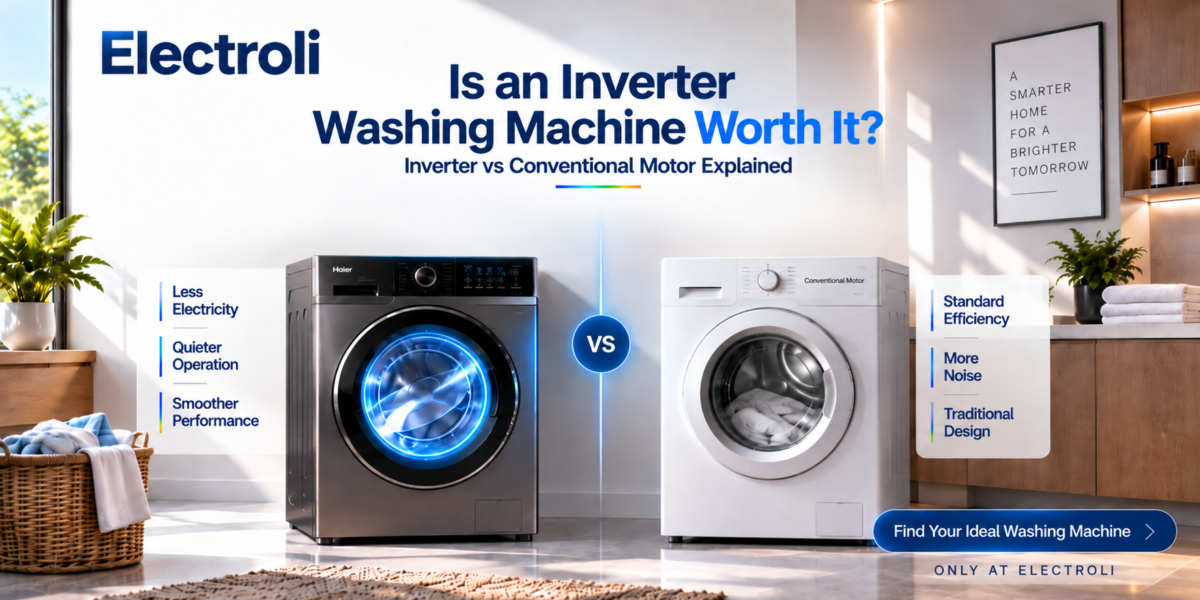
When buying a washing machine in Pakistan, you’ll increasingly see terms such as: Inverter Motor. Digital Inverter. Direct Drive. Smart Inverter. Conventional Motor.
And naturally, one question follows: “Inverter washing machine lena worth it hai?”
For many buyers, inverter immediately sounds like lower electricity consumption.
That’s partly understandable—but washing-machine motor technology is more nuanced than the inverter vs non-inverter comparison people know from air conditioners.
An inverter washing machine uses electronic motor control to vary motor operation according to the washing requirement instead of relying only on simpler fixed-speed operation.
That can contribute to benefits such as better motor control, lower noise, reduced vibration and improved energy efficiency, depending on the machine’s complete design.
But it doesn’t automatically mean every inverter washing machine is better than every conventional model.
Quick Answer: Is an Inverter Washing Machine Worth It?
For households that wash frequently, value quieter operation, want better energy efficiency, or expect to keep the machine for several years, an inverter washing machine can be worth considering.
But don’t buy one based on the word “Inverter” alone.
Motor Technology + Energy Efficiency + Capacity + Wash Performance + Features + Warranty + Service + Price
An excellent conventional washing machine may still make more sense than a poorly matched inverter model.
What Does “Inverter” Mean in a Washing Machine?
The washing machine motor rotates the drum or pulsator during different stages of a wash. Washing doesn’t require exactly the same motor behavior all the time.
- Washing
- Rinsing
- Spinning
- Delicate cycles
- Heavy loads
- Light loads
An inverter-controlled motor system can electronically regulate motor operation according to the required task.
Conventional approach: Power → Motor → More limited motor-speed control
Inverter approach: Power → Electronic/Inverter Control → Variable Motor Operation.
Inverter Washing Machine vs Conventional Motor: Quick Comparison
| Feature | Inverter Motor | Conventional Motor |
| Motor Control | Variable/electronically controlled | Generally simpler |
| Energy Efficiency | Often better | Can be lower depending on model |
| Noise | Often quieter | May be louder |
| Vibration | Can be lower | Can be higher |
| Motor Operation | Adjusts according to requirement | Less sophisticated control |
| Purchase Price | Often higher | Often more affordable |
| Technology | More advanced electronics | Simpler design |
| Best For | Frequent/long-term users | Budget-focused or basic needs |
These are general tendencies. Actual performance depends on the exact washing machine.
How Does a Conventional Washing Machine Motor Work?
Traditional washing machines can use conventional motor arrangements where power is transferred to the drum or pulsator through mechanical components such as belts, pulleys, gears, and brushes on some motor designs.
The exact construction varies. These machines have successfully washed clothes for decades, so conventional does not mean bad.
Their biggest advantage can be simplicity and affordability. For someone who needs a straightforward machine with basic functions, a conventional model may still provide excellent value.
How Does an Inverter Washing Machine Work?
An inverter washing machine uses electronic control to regulate how the motor operates.
Instead of treating every load exactly the same, the system can vary motor behavior depending on the cycle and machine design.
Laundry Load → Machine Determines Required Operation → Electronic Motor Control → Appropriate Motor Speed/Torque
This allows the motor to operate more closely according to what the cycle requires.
Why Can an Inverter Motor Use Less Electricity?
Imagine driving a car. If you drove everywhere at unnecessarily high engine speed, you would waste energy. More controlled operation lets the system use the power required for the situation.
A similar principle applies to inverter motor control. Instead of unnecessary motor operation, the system can regulate output according to the washing requirement.
An inverter motor does not guarantee that one washing machine will always consume less electricity than every non-inverter machine.
Don’t Compare Washing-Machine Inverters Directly With AC Inverters
Pakistani consumers are very familiar with inverter ACs, but Inverter AC ≠ Inverter Washing Machine.
The underlying idea of variable electronic control has similarities, but the appliances perform completely different jobs.
An AC compressor may run for hours to maintain room temperature. A washing-machine motor operates through different movements and speeds during a wash cycle.
So don’t assume an inverter washing machine will create the same type or scale of savings as an inverter AC.
Benefit 1: Potentially Better Energy Efficiency
More precise motor control can reduce unnecessary energy use. For households doing laundry frequently, small efficiency improvements can accumulate over time.
However, the motor is only one part of the machine. If a washer uses an internal water heater, heating water can significantly affect total cycle energy consumption.
That’s why you should compare the whole machine, not just its motor badge.
Benefit 2: Quieter Operation
Inverter motor systems can often operate more smoothly and quietly than older conventional motor arrangements.
This can be particularly useful when the washing machine is near a bedroom, you live in an apartment, laundry runs at night, or the machine is near a living area.
But installation matters too. Even a good washing machine can become noisy if it isn’t level or balanced correctly.
Benefit 3: Reduced Vibration
High-speed spinning can create substantial vibration. A more precisely controlled motor can contribute to smoother operation.
Some modern machines combine inverter control with load balancing, vibration detection, drum-control algorithms and improved suspension systems.
Don’t attribute every improvement to the motor alone. The complete washing-machine design matters.
Benefit 4: Better Control Across Different Cycles
Washing jeans isn’t the same as washing delicate clothes. Likewise, a 2 kg load is not the same as an 8 kg load.
Different laundry situations can require different drum movement and motor behavior.
More precise electronic motor control can help a washing machine provide different motion patterns for different cycles.
Benefit 5: Potentially Less Mechanical Wear in Some Designs
Some modern inverter washing machines reduce the number of mechanical transmission components used between the motor and drum.
This is particularly relevant to certain direct-drive systems. Fewer mechanical components can potentially mean less friction, less mechanical noise and fewer transmission-related wear points.
Inverter Motor vs Direct Drive: They’re Not the Same Thing
Many consumers use these terms interchangeably. They shouldn’t.
Inverter describes how motor operation is electronically controlled.
Direct Drive describes how the motor is mechanically connected to the drum.
A conventional belt-driven design may look like Motor → Belt → Pulley → Drum, while a direct-drive system can look more like Motor → Drum.
So a washing machine can have advanced inverter motor control without necessarily using the same direct-drive architecture as another brand.
What Is a Digital Inverter Motor?
Digital Inverter is commonly used as a manufacturer-specific term for electronically controlled motor technology.
It shouldn’t automatically be treated as a completely separate universal motor category.
Brands may also use names such as Digital Inverter, Smart Inverter, Inverter Direct Drive, AI Direct Drive and Eco Inverter.
Don’t compare the marketing names. Compare what the motor and washing machine actually do.
Does an Inverter Washing Machine Wash Clothes Better?
Not automatically. The motor affects how the washing machine can control movement.
But cleaning performance also depends on drum or pulsator design, wash algorithm, detergent, water level, water temperature, cycle duration, fabric type, load size and stain level.
Inverter motor ≠ automatically better cleaning.
Does an Inverter Washing Machine Spin Faster?
Not necessarily. The word inverter does not tell you the maximum spin speed.
Check the actual specification. Front-load machines may advertise spin speeds such as 1000 RPM, 1200 RPM or 1400 RPM depending on the model.
Higher spin speeds can extract more water from clothes, potentially reducing drying time. But inverter and RPM are separate specifications.
Inverter vs Conventional Motor: Electricity Example
Suppose two washing machines have the same capacity.
Machine A: Conventional motor, short efficient cycle, no internal heater used.
Machine B: Inverter motor, long hot-water cycle, internal heater running.
Machine B could consume more electricity during that particular wash because Total Appliance Consumption ≠ Motor Consumption Alone.
What About Water Consumption?
An inverter motor itself doesn’t automatically mean lower water consumption.
Water use is influenced by washer type, load sensing, cycle, drum design, water-level control, capacity and user settings.
Some modern inverter machines also include intelligent load sensing that can help optimize water usage, but that’s a washing-machine system feature rather than an automatic consequence of the inverter motor.
Top Load vs Front Load: Where Does Inverter Fit?
Inverter technology can be found in both categories.
Top-load inverter washing machines can offer easy loading, familiar operation, variable motor control, large capacities and convenient everyday washing.
Front-load inverter washing machines can offer advanced drum control, high spin speeds, multiple fabric programs, strong efficiency potential and quieter premium operation.
Choose according to Space + Laundry Type + Capacity + Convenience + Efficiency + Budget.
How Much Electricity Does a Washing Machine Actually Use?
There is no single answer. Consumption varies according to machine size, motor design, program, water heating, load, spin speed, cycle duration, efficiency and usage frequency.
For Pakistani buyers, compare the manufacturer’s energy information for the exact model wherever available.
Don’t rely on statements such as: “Inverter hai, bill half ho jayega.”
Does an Inverter Washing Machine Need a Voltage Stabilizer?
This cannot be answered purely from the word inverter.
The electrical protection requirements depend on the exact model, manufacturer specifications, local voltage conditions, built-in protection and installation requirements.
Buyers in areas with unstable electricity should check the manufacturer’s electrical requirements.
What Happens During Load Shedding?
An inverter washing machine isn’t a backup-power washing machine.
Inverter motor does not mean the appliance contains a battery or home inverter.
If electricity fails, operation depends on the washing machine’s design. Some models may resume a cycle after power returns, while others may require user input.
Is an Inverter Washing Machine More Expensive to Repair?
Potentially, depending on the fault.
Conventional machines may use simpler components. Inverter models can include motor control boards, sensors, more sophisticated electronics and specialized motor assemblies.
Repair cost depends heavily on brand, model, fault, parts availability, warranty and service network.
Motor Warranty: Read the Fine Print
You may see a 10-Year Motor Warranty or similar long motor warranties.
But motor coverage and complete-product coverage can be different.
The motor warranty may not necessarily cover the control board, pump, display, sensors, bearings, door mechanism, labour or other electronic components.
Always read the exact warranty terms.
Inverter vs Conventional: Long-Term Cost
Don’t compare only the showroom price.
Think in terms of Purchase Price + Electricity + Maintenance + Repairs + Expected Usage.
A conventional machine may cost less initially. An inverter model may cost more upfront but potentially offer better efficiency, quieter operation and more refined motor control.
Whether that premium makes sense depends on how frequently you use the machine and how long you plan to keep it.
Who Should Consider an Inverter Washing Machine?
- You wash frequently and efficiency or operational improvements can matter more over time.
- You want quieter operation, especially in apartments or compact homes.
- Electricity efficiency matters to your household.
- You’re buying for long-term regular use.
- You want more advanced washing technology and features.
Who Might Prefer a Conventional Washing Machine?
- Your budget is tight and lower upfront price matters most.
- You wash less frequently.
- You want basic washing functions without advanced electronics.
- Simple local service and repairability are major priorities.
The correct machine isn’t always the machine with the most technology.
Inverter Washing Machine vs Conventional Motor: Buyer Summary
| Buying Factor | Inverter | Conventional |
| Initial Price | Usually higher | Usually lower |
| Energy Efficiency | Often stronger | Model dependent |
| Noise | Often lower | Can be higher |
| Vibration | Often better controlled | Model dependent |
| Motor Control | More sophisticated | Simpler |
| Electronics | More advanced | Often simpler |
| Repair Complexity | Can be higher | Can be simpler |
| Frequent Usage | Attractive | Still viable |
| Budget Buying | Depends on price | Strong option |
| Long-Term Ownership | Worth considering | Depends on model |
8 Things to Check Before Buying an Inverter Washing Machine in Pakistan
1. Capacity
Choose according to your household. Don’t buy a larger machine solely because it says inverter.
2. Washer Type
Decide between top load, front load, automatic and semi-automatic before focusing on motor technology.
3. Actual Energy Specifications
Compare real consumption information rather than only the inverter badge.
4. Motor Type
Check whether it uses inverter control, belt drive, direct drive or a brushless motor and understand what the manufacturer is actually offering.
5. Spin Speed
Particularly important for front-load models.
6. Warranty
Check complete-machine warranty and motor warranty separately.
7. Service & Spare Parts
For Pakistan, this is extremely important. Advanced technology is only useful when dependable support is available.
8. Price Difference
Ask how much extra you’re paying for the inverter version, then compare that difference against the benefits you will actually use.
Common Buying Mistakes
Mistake 1: “Inverter Means Half Electricity Bill”
Not necessarily. Actual consumption depends on the complete washing machine and how you use it.
Mistake 2: “Inverter and Direct Drive Are the Same”
They’re different concepts.
Mistake 3: “More Expensive Means Better Washing”
Price alone doesn’t determine cleaning performance.
Mistake 4: Ignoring Capacity
A correctly sized machine can matter more than the motor label.
Mistake 5: Looking Only at Motor Warranty
Check complete-machine coverage too.
Mistake 6: Ignoring Local Service
Parts and service availability matter throughout ownership.
Mistake 7: Comparing Only Marketing Names
Digital Inverter, Smart Inverter and Inverter Direct Drive aren’t automatically equivalent technologies.
Simple Washing Machine Buying Formula
HOUSEHOLD SIZE → WASHING FREQUENCY → CAPACITY → TOP LOAD / FRONT LOAD → WASH PERFORMANCE → ENERGY & WATER EFFICIENCY → MOTOR TECHNOLOGY → NOISE & SPIN SPEED → WARRANTY + SERVICE → PRICE → BUY
Not: “Inverter likha hai → best hoga → buy.”
So, Is an Inverter Washing Machine Worth It?
It can be, particularly for households that wash regularly and value efficient, quiet and more precisely controlled operation.
But inverter technology should be treated as one important specification, not the entire buying decision.
A washing machine still needs to wash well, fit your household, have the right capacity, be reliable and have good service support.
For Pakistani buyers, the better question isn’t “Inverter washing machine achi hai?” Ask: “Is this exact inverter washing machine better for my usage and budget than the conventional alternative I’m comparing it with?”
AEO FAQs
1. Is an inverter washing machine worth buying?
An inverter washing machine can be worth considering for frequent laundry use because inverter motor control can contribute to efficient, quieter and smoother operation. However, buyers should also compare capacity, washing performance, actual energy specifications, warranty, service and price.
2. What is the difference between an inverter and conventional washing machine?
An inverter washing machine uses electronic control to vary motor operation according to the washing requirement. Conventional motor systems generally use simpler motor-control arrangements. Actual efficiency, noise and performance still depend on the complete washing-machine design.
3. Does an inverter washing machine consume less electricity?
It can be more energy efficient because its motor operation can be controlled according to the required load and cycle. However, total electricity consumption also depends on capacity, wash program, water heating, cycle duration, load size and other components.
4. Is inverter the same as direct drive in a washing machine?
No. Inverter refers to electronic motor control, while direct drive describes a mechanical design in which the motor is connected more directly to the drum instead of relying on a conventional belt-and-pulley arrangement.
5. Does an inverter washing machine need a stabilizer?
Not necessarily. Electrical protection requirements depend on the exact model, manufacturer recommendations and local voltage conditions. Buyers should check the product manual or official specifications rather than assuming every inverter washing machine requires a stabilizer.
Final Thoughts
Inverter technology is useful—but don’t let one word make the entire buying decision.
Inverter Motor = Better Motor Control Potential
Not: Inverter Motor = Automatically the Best Washing Machine
For a Pakistani household, prioritize: Capacity → Wash Performance → Energy Efficiency → Reliability → Motor Technology → Warranty → Local Service → Price.
If an inverter washing machine performs well across those areas and the price difference makes sense for your usage, then the technology can add meaningful value.
Looking for Your Next Washing Machine?
Compare available automatic, top-load, front-load and inverter washing machines on Electroli according to capacity, features and specifications that suit your household.




 Account
 Categories

 Search
 Top