


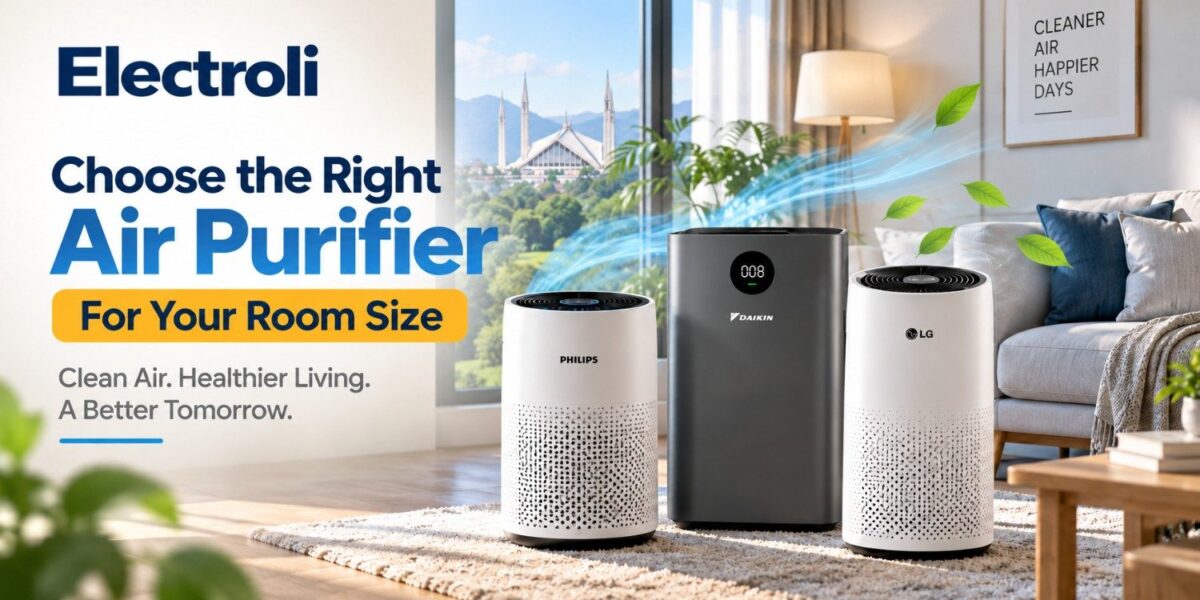
Air Purifier Lena Hai? Sirf Brand Aur Price Dekh Kar Decide Mat Karein.
Air purifier shopping can become confusing very quickly. One model says HEPA. Another highlights CADR. Another claims coverage for a large room. And then you see different filters, sensors, modes and specifications.
So which one should you buy?
The first question should not be “Best air purifier konsa hai?” A better question is: “Mere room ke size aur usage ke liye konsa air purifier suitable hai?”
An air purifier that works well for a small bedroom may not provide the same air-cleaning performance in a much larger living room. This guide explains what Pakistani buyers should check before choosing one.
Quick Answer: What Size Air Purifier Do I Need?
Room Size → CADR → Filtration → Filter Availability → Noise → Energy Use → Sensors & Features → Maintenance
Start with your room size, then check whether the manufacturer’s stated coverage and performance are suitable for that space. Do not select an air purifier simply because it looks large or has a long list of smart features. The air-cleaning specifications matter more.
1. Start by Measuring Your Room
Before comparing air purifiers, know the approximate size of the room where you will use one.
For a rectangular room: Room Length × Room Width = Floor Area.
Example: 12 ft × 14 ft = 168 sq. ft.
You now have a much better starting point for comparing the manufacturer’s recommended coverage.
Why does room size matter? A purifier designed for a relatively small space may still move and filter some air in a very large living room, but it may not deliver the level of air cleaning you expected for that larger space.
Purifier size should follow room size – not just your budget.
2. Understand CADR Before Buying
One specification worth understanding is CADR – Clean Air Delivery Rate.
In simple terms, CADR is a standardized measure related to how much filtered air a purifier can deliver for specific pollutants under test conditions.
AHAM’s Verifide program uses CADR ratings for tobacco smoke, dust and pollen, and provides room-size guidance based on smoke CADR.
The practical takeaway: when comparing two purifiers for the same room, do not look only at physical size – look at their verified air-cleaning performance too.
A physically larger purifier is not automatically the stronger performer. Check the specifications.
3. Room Coverage and CADR Are Not the Same Thing
You may see a product advertised as “Coverage: 500 sq. ft.” and assume that is all you need to know. Not necessarily.
Coverage claims can depend on assumptions about how often the air in that space is cleaned. A more useful comparison includes recommended room area, CADR, air-change assumptions and operating speed used for the rating.
AHAM notes that its suggested room-size figure is based on the ability to reduce smoke particles in a room and recommends a smoke CADR of at least two-thirds of the room’s area in square feet under its methodology.
Example: for a 150 sq. ft. room, that rule of thumb corresponds to roughly 100 smoke CADR (cfm). This is a guideline, not a substitute for checking the exact purifier’s certified specifications and intended conditions.
4. What Is a HEPA Filter?
HEPA stands for High-Efficiency Particulate Air.
According to the U.S. EPA, a HEPA filter can theoretically remove at least 99.97% of airborne particles measuring 0.3 microns that pass through the filter.
That makes HEPA filtration particularly relevant when you are buying a purifier primarily for airborne particles.
Do not judge the whole purifier by the word “HEPA” alone. Overall performance also depends on factors such as airflow through the unit, filter fit/design, operating speed and room suitability.
5. HEPA vs Activated Carbon – What’s the Difference?
HEPA or particle filtration is designed primarily for airborne particles such as dust, pollen, some smoke particles and other airborne particulate matter.
Activated carbon is used to adsorb certain gases and odors. EPA notes that filtration for gases requires media such as activated carbon or other materials designed for gas removal, while particle filters do not remove gases.
Easy way to remember: HEPA → Particles. Carbon → Certain gases & odors.
If both are concerns in your home, investigate the purifier’s complete filtration system rather than focusing on a single filter layer.
6. Air Purifier for Smog in Pakistan – What Should You Check?
For Pakistani buyers, this can be particularly relevant during periods of elevated outdoor particle pollution.
When particulate pollution is your primary concern, pay particular attention to appropriate room coverage, CADR, particle filtration, replacement-filter availability, ability to run the purifier consistently, and door/window leakage and outdoor-air entry.
EPA notes that portable air cleaners can help improve indoor air quality, but no air cleaner removes all pollutants from indoor air.
Think of an air purifier as one part of indoor air-quality management, not a magic shield against every pollutant.
7. Don’t Forget Replacement Filters
This is one of the easiest buying mistakes to make. A purifier may look affordable today, but what happens when its filter needs replacement?
Before buying, check whether the replacement filter is readily available. Also check its model number, recommended replacement interval, approximate replacement cost, whether multiple filters require replacement, and whether filters can be purchased locally.
Electroli Buying Tip: Air purifier ki price sirf machine ki price nahi hoti. Filter cost bhi ownership cost ka part hai.
A cheaper purifier with expensive or difficult-to-find filters may become inconvenient over time.
8. Check Noise Level – Especially for Bedrooms
An air purifier may operate for long periods. If it is going into your bedroom, study area or office, noise becomes important.
Many purifiers have multiple fan speeds. Higher speeds can increase airflow and cleaning performance, but they can also increase noise.
When available, compare the manufacturer’s dB (decibel) rating at different operating speeds. For bedrooms, also check sleep mode, reduced display brightness, lower fan-speed settings and timer functions.
The right purifier is one you are comfortable actually running.
9. How Much Electricity Does an Air Purifier Use?
Air purifiers are often operated for extended periods, so power consumption is worth checking.
Estimate electricity consumption using: Power (kW) × Operating Hours = kWh / Electricity Units.
Example: a 50W purifier equals 0.05kW. If it operates for 10 hours at that power, 0.05 × 10 = 0.5 kWh, or approximately 0.5 electricity units. Over 30 similar days, that equals about 15 kWh.
Actual consumption can differ because some models vary power use by fan speed, sensors or operating mode. Use the exact model’s rated specifications when estimating.
10. Do You Need an Air-Quality Sensor?
Many modern air purifiers include built-in air-quality sensors. Depending on the model, they may display or respond to measurements related to airborne particles.
Useful features can include Auto Mode, an air-quality indicator, and app monitoring.
Smart features should come after core purification performance – not before it. A beautiful app does not compensate for a purifier that is not suitable for your room.
11. Where Should You Place an Air Purifier?
Even a good purifier can perform poorly if airflow is unnecessarily obstructed. Always follow the manufacturer’s placement instructions.
In general, avoid placing the purifier where the air intake is blocked, the air outlet is covered, curtains obstruct airflow, or furniture tightly surrounds the unit.
The goal is to allow the purifier to draw room air in and return filtered air effectively. Do not hide it in a corner simply because it looks cleaner there.
12. One Large Air Purifier or Multiple Small Ones?
It depends on your home’s layout. An air purifier in one closed room does not automatically clean every other room in the house effectively.
Walls, doors and airflow between spaces matter. A bedroom with a closed door and a purifier inside is very different from expecting one purifier in a hallway to clean several closed bedrooms.
For multiple rooms, you may need to evaluate each occupied space separately.
13. Should You Buy a Purifier With an Ionizer?
Some air-cleaning devices use ionization or other electronic air-cleaning technologies. Buyers should pay attention to ozone emissions.
EPA advises against using ozone generators in occupied spaces and notes that some ionizers and other electronic air cleaners may emit ozone.
If a purifier includes an ionization feature, investigate whether it can be switched off, manufacturer documentation, relevant safety/certification information and ozone-emission information.
Do not assume that more purification technologies automatically mean a better product.
14. Do Air Purifiers Remove Smells?
It depends on the filtration system and the source of the smell. A particle filter is not designed to remove every gas or odor.
Activated-carbon or other gas-phase filtration may help with certain gaseous pollutants and odors, but effectiveness depends on the media, quantity and pollutant involved.
If odor control matters to you, check whether the purifier includes a meaningful gas/odor filtration stage rather than assuming HEPA alone will solve it.
15. Air Purifier for Bedroom: What Matters Most?
For a bedroom, prioritize correct room sizing, particle-cleaning performance, noise, display controls, filter availability and energy consumption.
A feature-packed purifier is not necessarily the best bedroom purifier.
16. Air Purifier for a Living Room: What Changes?
Living rooms can be larger and more open than bedrooms. Consider larger room area, open-plan connections, higher airflow requirements, more people occupying the space, doors opening frequently and air entering from adjoining spaces.
Do not buy a purifier sized for a small bedroom and expect identical performance in a large open lounge.
7 Things to Check Before Buying an Air Purifier
| Check | What to Look For |
| 1. Room Size | Measure the space where it will operate |
| 2. CADR | Compare air-cleaning performance |
| 3. Filtration | HEPA/particle + carbon where relevant |
| 4. Replacement Filters | Availability, interval and ongoing cost |
| 5. Noise | Especially for bedrooms and offices |
| 6. Electricity Use | Wattage and expected operating hours |
| 7. Extra Features | Sensors, auto mode, sleep mode and app control |
Save this checklist before you start comparing models.
Common Air Purifier Buying Mistakes
Mistake 1: Buying by Brand Only
A trusted brand can matter, but the purifier still needs to suit your room and requirements.
Mistake 2: Ignoring Room Size
A purifier that is undersized for the intended room may not deliver the performance you expect.
Mistake 3: Thinking “HEPA” Tells You Everything
Filter type is important, but airflow and overall purifier performance matter too.
Mistake 4: Forgetting Replacement Filters
Always investigate ongoing filter availability and cost.
Mistake 5: Choosing by Features Instead of Performance
Wi-Fi, apps and displays are useful extras – not substitutes for suitable air-cleaning performance.
Mistake 6: Assuming One Purifier Cleans the Whole House
Separate rooms and closed doors can change airflow significantly.
Mistake 7: Assuming More Technology Is Always Better
Investigate technologies such as ionizers carefully, including ozone considerations.
How to Choose the Right Air Purifier – Simple Decision Path
MEASURE YOUR ROOM → CHECK RECOMMENDED COVERAGE → COMPARE CADR → CHECK FILTRATION → CHECK REPLACEMENT FILTERS → COMPARE NOISE & POWER USE → THEN COMPARE SMART FEATURES → CHOOSE THE SUITABLE AIR PURIFIER
FAQs
1. What size air purifier do I need for my room?
Measure your room’s floor area and compare it with the purifier manufacturer’s recommended room coverage and CADR. A purifier should be selected for the space where it will actually operate.
2. What is CADR in an air purifier?
CADR stands for Clean Air Delivery Rate. It is a standardized performance measure related to how much filtered air an air cleaner delivers for specific pollutants. Higher CADR generally indicates greater cleaning capacity for the pollutant being rated under the test conditions.
3. Is a HEPA filter important in an air purifier?
HEPA filtration is useful for airborne particles. A HEPA filter is defined to remove at least 99.97% of 0.3-micron particles passing through it under its specified test conditions. Overall purifier performance also depends on airflow and system design.
4. Can an air purifier help during smog season?
A suitably selected portable air cleaner can reduce airborne particles indoors, but it cannot eliminate every pollutant or replace other indoor-air-quality measures. Choose according to room size, particle-cleaning performance and filtration.
5. How often should an air purifier filter be changed?There is no universal replacement interval. It depends on the filter, purifier, usage and environmental conditions. Follow the replacement schedule and filter indicator specified by the manufacturer.
Final Thoughts
Choosing an air purifier becomes much easier once you stop asking “Best air purifier konsa hai?” and start asking “Mere room aur air-cleaning requirements ke liye konsa model suitable hai?”
Start with your room size. Then compare CADR, filtration, filter availability, noise, electricity consumption and maintenance. Finally, look at convenience features and price. That is a much more practical way to shop.
Looking for an Air Purifier in Pakistan? Explore available air purifiers on Electroli and compare models according to the specifications that matter for your room and household.
Electronics Chahiye? Electroli Se Le Lo.

 Account
 Categories

 Search
 Top