

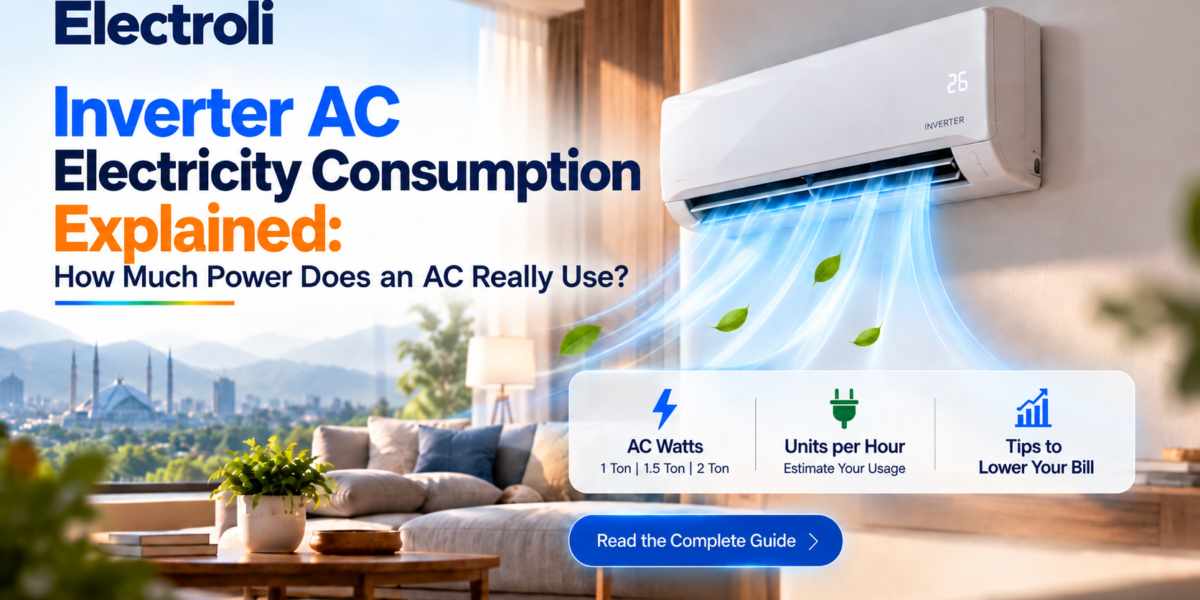
You turn on your inverter AC. The display says 26°C. The room becomes cool. But one question remains: How much electricity is my AC actually using right now?
Is a 1.5 ton inverter AC constantly consuming 1,500 or 2,000 watts? Does setting the temperature to 16°C make it consume more electricity? And does an inverter AC really save electricity compared with a conventional AC?
The biggest misconception is that an inverter AC consumes one fixed amount of electricity every hour. It doesn’t.
Pakistan’s energy regulations define an inverter room AC as one that can vary compressor output instead of controlling it only through start-stop operation.
Your AC’s electricity consumption depends on AC capacity + efficiency + compressor load + room conditions + temperature setting + operating time.
Quick Answer: How Much Electricity Does an Inverter AC Use?
| AC Size | Inverter AC Reference | Conventional AC Reference |
| 1 Ton | 900 W | 1,500 W |
| 1.5 Ton | 1,200 W | 2,000 W |
| 2 Ton | 1,500 W | 2,500 W |
These are useful representative reference assumptions from NEECA’s consumer calculator, not a promise that every inverter AC continuously consumes exactly that wattage.
An inverter AC’s power draw changes as cooling demand changes. Do not assume that a 1.5 ton inverter AC always equals exactly 1.2 electricity units every hour.
First: What Is an Electricity “Unit”?
In Pakistan, when people ask “AC kitne units consume karta hai?”, one electricity unit means 1 kilowatt-hour (kWh).
Electricity Used (kWh) = Power (kW) × Time (hours).
If an appliance actually draws 1,000 watts (1 kW) continuously for one hour, it uses 1 kWh – one electricity unit.
Example: 1.5 Ton Inverter AC
NEECA’s calculator uses 1,200W as its representative rating for a 1.5 ton inverter AC.
If an AC continuously drew exactly 1.2 kW for one hour, it would use 1.2 kWh, or 1.2 electricity units.
But a variable-capacity AC may not continue drawing 1.2 kW for the entire hour. Once the room approaches the target temperature, compressor output can reduce.
Rated/reference wattage does not equal guaranteed hourly energy consumption.
1. How Does an Inverter AC Work?
A conventional non-inverter AC primarily controls cooling through compressor cycling: COMPRESSOR ON → COOL ROOM → COMPRESSOR OFF → ROOM WARMS → COMPRESSOR ON.
An inverter AC can instead adjust compressor output: HOT ROOM → HIGHER COMPRESSOR OUTPUT → ROOM APPROACHES SET TEMPERATURE → COMPRESSOR SLOWS → TEMPERATURE MAINTENANCE → LOWER OUTPUT AS NEEDED.
Variable-speed operation can better match cooling output to actual cooling load, which is the fundamental reason inverter technology can improve seasonal efficiency.
2. Why Doesn’t an Inverter AC Use Fixed Watts?
Your room’s cooling requirement isn’t fixed. When a hot room first starts cooling, the AC may operate relatively hard.
Later, when the room reaches approximately the desired temperature, it only needs to deal with heat entering from walls, windows, roof, doors, people, electronics, outdoor air leakage and sunlight.
The cooling load falls, so the compressor can reduce its output.
A better question than “1.5 ton inverter kitne watts leta hai?” is: “How much energy does this AC use over several hours under my room conditions?”
3. 1 Ton vs 1.5 Ton vs 2 Ton: What Does “Ton” Mean?
AC tonnage describes cooling capacity, not electricity consumption directly.
A commonly used approximation is: 1 Ton ≈ 12,000 BTU/h; 1.5 Ton ≈ 18,000 BTU/h; 2 Ton ≈ 24,000 BTU/h.
A 2 ton AC is designed to provide more cooling capacity than a 1 ton AC, but it does not automatically use exactly twice the electricity. Efficiency, compressor modulation, room load and operating conditions also matter.
4. Approximate Inverter AC Power References in Pakistan
Using NEECA’s consumer calculator as a simple reference: 1 Ton = 900W, 1.5 Ton = 1,200W, and 2 Ton = 1,500W.
Always check the actual model’s rated power input, maximum input, cooling capacity, EER, CSPF and Pakistan Energy Label before estimating its consumption.
5. How Many Units Does an AC Use Per Hour?
Using the reference values purely for calculation: 1 Ton at 900W would equal 0.9 kWh if maintained continuously for one hour; 1.5 Ton at 1,200W would equal 1.2 kWh; 2 Ton at 1,500W would equal 1.5 kWh.
These are not guaranteed real-world hourly figures. An inverter compressor may operate above or below a representative draw as cooling demand changes.
The most accurate way to know actual consumption is to measure the AC’s energy use over time or use reliable model-specific tested data.
6. What Happens Over 8 Hours?
Multiplying 1.2 kW × 8 hours gives 9.6 kWh only if the AC actually draws 1.2 kW continuously for all eight hours.
An inverter AC may vary compressor output throughout the period as the room approaches and maintains the target temperature.
Rated watts × hours can estimate a reference scenario, but it may not represent actual inverter operation.
7. Why Can Two Identical ACs Have Different Electricity Consumption?
Two homes can use the same 1.5 ton inverter AC for the same number of hours but consume different amounts of electricity.
Direct afternoon sunlight, top-floor roof exposure, large windows, poor insulation, frequent door opening, more occupants, gaming PCs, televisions and air leakage can all increase cooling load.
Same AC. Different cooling load. Different energy use.
8. Does Setting the AC to 16°C Cool the Room Faster?
Setting 16°C does not necessarily give the AC extra cooling capacity beyond what the system can provide. It gives the system a much lower temperature target.
That can cause the compressor to operate at higher output for longer because the room has further to cool.
If your comfort target is around 24-26°C, setting the AC unnecessarily low can increase cooling demand.
9. 24°C vs 26°C: Does Temperature Setting Affect Electricity Use?
Yes. The greater the temperature difference between outdoors and your indoor target, the more heat the AC generally needs to remove.
The exact energy difference cannot be predicted from thermostat setting alone because weather, building construction, humidity, AC efficiency and room load also matter.
More demanding indoor temperature can mean greater cooling energy requirement.
10. What Is EER?
EER means Energy Efficiency Ratio. Pakistan’s energy-label regulations define it as the ratio of total cooling capacity to effective power input under specified rating conditions.
In simple terms: how much cooling do I get for the electricity being used?
Wattage alone doesn’t tell you whether an AC is efficient.
11. What Is CSPF?
CSPF means Cooling Seasonal Performance Factor.
NEECA defines CSPF as the ratio between total annual cooling provided in active cooling mode and total annual energy consumed during the same period.
Think of EER as efficiency at specified test conditions, while CSPF represents efficiency across a cooling season.
For an inverter AC that operates at varying compressor speeds, seasonal efficiency can be especially useful when comparing models.
12. Pakistan Energy Label: Don’t Ignore It
Pakistan has an official energy-label framework for room air conditioners.
NEECA’s system uses minimum energy-performance requirements and a 1-to-5-star rating, with higher star ratings indicating greater energy efficiency.
A practical comparison should include Cooling Capacity + CSPF/Efficiency + Energy Label + Power Input + Warranty + Room Suitability.
13. Inverter vs Non-Inverter AC Electricity Consumption
NEECA’s calculator uses representative values of 1,500W vs 900W for 1 Ton, 2,000W vs 1,200W for 1.5 Ton, and 2,500W vs 1,500W for 2 Ton conventional vs inverter ACs.
These figures should not be interpreted as a universal promise that every inverter AC will save exactly 40%.
Actual savings depend on specific models and operating conditions.
14. Does an Inverter AC Always Save Electricity?
Not automatically. An efficient inverter AC in a room with an open door, strong direct sunlight, poorly sealed windows, undersized capacity or an extremely low temperature setting may still work hard for long periods.
Inverter technology provides the ability to reduce output when cooling load falls. It cannot eliminate the cooling load itself.
Inverter technology + correct sizing + efficient AC + sensible use = better opportunity for energy savings.
15. Can an Oversized AC Waste Electricity?
Bigger is not automatically better. Oversizing can affect comfort, cycling/modulation behavior, humidity control and cost.
Undersizing is also a problem because an undersized AC may struggle to reach the desired temperature and operate at high output for extended periods.
The goal is correct AC size for the room’s cooling load, not the largest tonnage within budget.
16. Why Room Size Matters
A bedroom and a large lounge do not have the same cooling requirement. Even rooms with identical floor area can require different AC capacities.
Important factors include room dimensions, ceiling height, floor level, roof exposure, window area and direction, direct sunlight, occupants, electronics, insulation, city/climate and exterior walls.
A simple square-feet-to-tonnage rule should only be treated as an initial estimate.
17. Top-Floor Rooms Can Consume More Cooling Energy
A room directly below a sun-exposed roof can receive substantial heat during hot weather.
Higher cooling load can mean higher compressor output and greater energy consumption.
Roof insulation, shading and reflective treatments can influence AC energy use indirectly by reducing room heat gain.
18. Windows Can Make a Huge Difference
Large windows can increase cooling demand through solar heat gain, heat conduction and air leakage.
A west-facing room receiving strong afternoon sun can behave very differently from a shaded room of the same size.
Curtains, blinds, exterior shading, better glazing and weather sealing can reduce heat entering the room.
19. Opening the Door Frequently Costs Cooling
Every time a door opens, conditioned indoor air can mix with warmer outdoor or adjacent-room air.
Repeated opening over hours can add to cooling load. Keep the cooled space reasonably enclosed for efficient operation.
20. Does Fan Speed Affect AC Electricity Consumption?
Yes, but the compressor is usually the major electrical load in a split AC.
Increasing indoor fan speed can increase fan electricity use somewhat, but the main energy factors remain cooling demand, compressor operation, AC efficiency, temperature setting, room heat gain and operating time.
21. What Is T3 Inverter Technology?
T3 generally refers to equipment intended and tested for higher-temperature climatic conditions than standard T1 conditions.
This matters in areas where extreme summer temperatures challenge AC performance.
T3 does not automatically mean lowest electricity consumption. Operating capability and efficiency are not identical.
22. Does Turbo Mode Consume More Electricity?
Turbo mode typically asks the AC to cool the room aggressively, which can mean higher compressor output and fan speed.
Instantaneous power consumption may be higher while turbo mode is active, but total energy impact depends on how long it operates and what happens afterward.
Use turbo when rapid cooling is genuinely needed.
23. Sleep Mode Can Be Useful
Sleep modes often gradually adjust temperature or fan behavior during the night.
That can improve comfort and potentially reduce unnecessary cooling compared with maintaining an excessively low setting all night.
Exact behavior differs by brand and model, so check the product manual.
24. Dirty Filters Can Affect AC Performance
Indoor AC filters collect dust, hair, fibres and airborne debris. As they become clogged, airflow can be restricted.
Poor airflow can reduce performance and make the system work less effectively.
Regular filter cleaning according to manufacturer instructions is one of the simplest AC maintenance tasks.
25. Outdoor Unit Condition Matters Too
The outdoor unit must reject heat from your room to the outside environment.
If airflow around the condenser is badly restricted by dirt, debris, improper placement or physical obstruction, performance can suffer.
Installation quality matters just as much as buying the right AC.
26. How Do You Calculate Your AC’s Electricity Cost?
Use: Electricity Cost = kWh Used × Applicable Electricity Rate.
If an AC uses 5 kWh and the effective electricity cost were hypothetically PKR 60/kWh, the cost would be PKR 300.
Pakistan’s electricity tariffs can vary by consumer category, consumption slab, taxes, surcharges and other billing factors, so use the rate applicable to your actual bill.
27. Don’t Estimate Your Bill From Watts Alone
Maximum input can tell you how much power the machine may draw under certain conditions. It does not necessarily tell you how much energy it will use across an entire cooling season.
That’s why efficiency metrics such as CSPF matter.
28. How Can You Measure Actual AC Electricity Consumption?
If you want the most accurate answer for your own AC, measure it using an appropriately rated dedicated energy meter, smart energy monitoring system, suitable AC circuit monitoring or smart meter data where available.
For a high-power appliance such as a split AC, measurement equipment must be correctly rated and safely installed.
Once measured, you can calculate daily, weekly and monthly kWh.
29. Example Monthly AC Calculation
Suppose actual measured average energy use is 0.8 kWh per hour and the AC runs 8 hours per day. That is 0.8 × 8 = 6.4 kWh/day, or 192 kWh/month over 30 days.
If average consumption were 1.2 kWh/hour, the same schedule would use 288 kWh/month.
That’s a difference of 96 units per month, illustrating why actual average consumption matters more than the word inverter.
30. What Can Reduce Inverter AC Electricity Consumption?
Use a sensible temperature, close doors and windows, block direct sunlight, clean filters, choose correct AC capacity, improve insulation, maintain the AC, use timers/scheduling and compare energy labels before purchase.
You don’t need to sacrifice all comfort; start by reducing unnecessary cooling load.
AC Electricity Consumption: Myth vs Reality
| Myth | Reality |
| Inverter AC uses fixed watts | Power can vary with compressor load |
| 1.5 ton means 1.5 units/hour | Tonnage describes cooling capacity |
| 16°C cools instantly | It mainly creates a lower target |
| Every inverter saves the same amount | Efficiency and conditions differ |
| T3 always means lower bill | T3 capability and efficiency aren’t identical |
| Bigger AC is always better | Correct sizing matters |
| Watts alone show efficiency | Cooling output and seasonal efficiency matter |
| Turning AC on is the only factor | Room heat gain strongly affects consumption |
What Should Pakistani Buyers Check Before Buying an Inverter AC?
1. Correct Tonnage
Match the AC to the room.
2. Pakistan Energy Label
Look for verified efficiency information and compare star ratings.
3. CSPF
Useful for comparing seasonal cooling efficiency.
4. Rated & Maximum Power Input
Know the electrical requirements.
5. Cooling Capacity
Don’t compare tonnage labels alone.
6. T1/T3 Suitability
Important depending on local climate.
7. Compressor Warranty
Check both duration and conditions.
8. Installation Requirements
Copper length, wiring, breaker, vacuuming and placement matter.
9. After-Sales Support
Important for long-term ownership.
10. Price vs Running Cost
The cheapest AC to purchase may not be the cheapest AC to operate.
Inverter AC Electricity-Saving Formula
CORRECT AC SIZE → HIGHER VERIFIED EFFICIENCY → PROPER INSTALLATION → REASONABLE TEMPERATURE → REDUCE ROOM HEAT GAIN → CLEAN FILTERS → KEEP DOORS/WINDOWS CLOSED → USE ONLY WHEN NEEDED → MEASURE ACTUAL kWh
Not: “Inverter likha hai, bill automatically bohat kam ayega.”
AEO FAQs
1. How much electricity does a 1.5 ton inverter AC use per hour?
There is no single fixed figure because an inverter AC changes compressor output according to cooling demand. NEECA’s consumer calculator uses 1,200W as a representative rating for a 1.5 ton inverter AC; if 1.2kW were drawn continuously for one hour, that would equal 1.2kWh. Actual consumption can be higher or lower depending on the model and conditions.
2. How many units does an inverter AC consume in 8 hours?
It depends on the AC’s actual average power consumption. For example, an average of 0.8kWh per hour over eight hours equals 6.4kWh, or 6.4 electricity units. The most reliable estimate comes from measuring actual energy consumption rather than multiplying tonnage by hours.
3. Does an inverter AC save electricity compared with a non-inverter AC?
It can. An inverter AC varies compressor output rather than controlling it only through start-stop operation, allowing cooling capacity to better match changing room demand. Actual savings depend on model efficiency, sizing, temperature settings, climate, room heat gain and operating pattern.
4. Is 26°C better for electricity consumption than 18°C?
A higher, comfortable thermostat setting generally reduces cooling demand compared with maintaining a much colder indoor temperature under the same conditions. The exact saving cannot be predicted from temperature setting alone because weather, insulation, room load and AC efficiency also matter.
5. What should I check to find an energy-efficient inverter AC in Pakistan?
Check the Pakistan Energy Label, star rating, CSPF, cooling capacity, power input, appropriate tonnage and climate suitability. NEECA’s labeling framework uses efficiency testing and a 1-to-5-star system to help consumers compare room ACs.
Final Thoughts
So, how much electricity does an inverter AC really use? There isn’t one universal answer.
Not: 1 Ton = X units. Not: 1.5 Ton = Y units. And definitely not: “Inverter hai, is liye bill automatically half ho jayega.”
An inverter AC’s electricity use changes with its compressor output and the cooling demand placed on it.
For Pakistani households, the most useful way to think about AC electricity consumption is: AC Efficiency × Cooling Load × Operating Time = Your Real Energy Use.
The AC itself matters, but so do room size, sunlight, roof heat, insulation, temperature setting, installation, maintenance and usage habits.
So when comparing inverter ACs, don’t ask only “Kitne watts ka hai?” Ask: “How efficiently can this AC keep my actual room comfortable throughout the cooling season?”
That’s the question that matters for both comfort and your electricity bill.
Looking for an Energy-Efficient Inverter AC?
When comparing ACs on Electroli, look beyond tonnage and inverter labels. Compare CSPF, energy rating, cooling capacity, climate suitability, power input, warranty and correct room sizing before deciding.





 Account
 Categories

 Search
 Top