


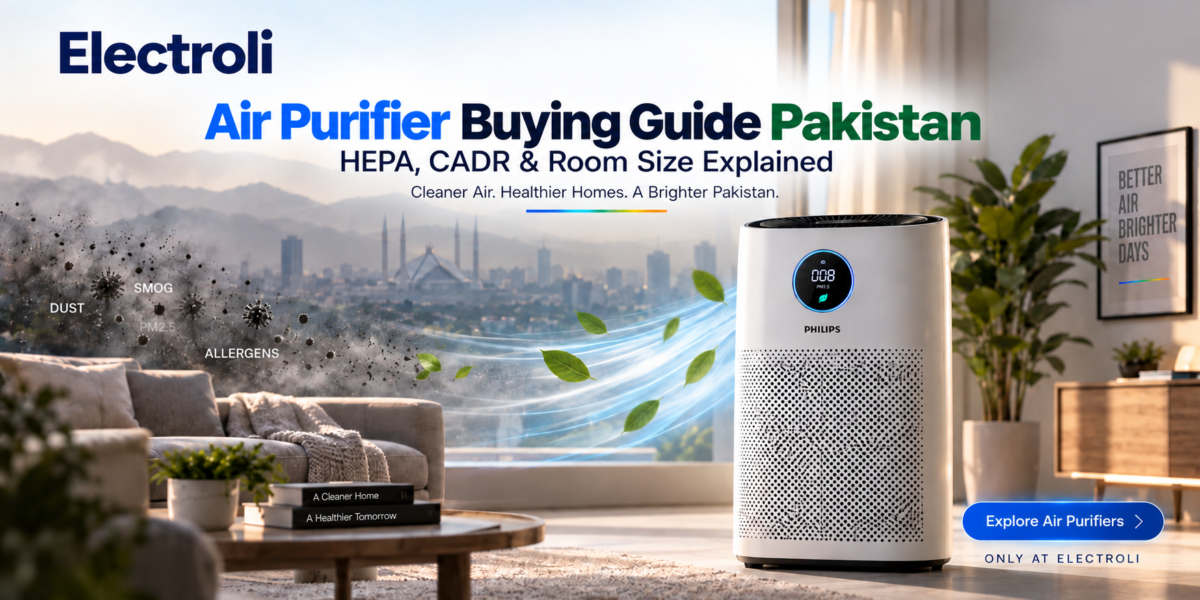
Buying an air purifier sounds simple. Find a machine that says HEPA Filter, 99% Filtration, Large Room or Smart Air Purification – and buy it.
But that’s exactly where many buyers can go wrong.
Two air purifiers may both advertise HEPA filtration while performing very differently in the same room.
Why? Because an air purifier isn’t just about the filter.
Three things matter together: FILTER + AIRFLOW + ROOM SIZE.
And one specification connects all three: CADR – Clean Air Delivery Rate.
For Pakistani buyers – particularly during periods when outdoor particulate pollution is a concern – understanding these specifications is much more useful than simply choosing the purifier with the biggest marketing claims.
Quick Answer: What Should You Look for in an Air Purifier?
| Feature | What to Look For |
| Particle Filter | HEPA / clearly specified high-efficiency filtration |
| CADR | Appropriate for your room size |
| Room Coverage | Match to actual room dimensions |
| PM2.5 | Particle filtration capability matters |
| Carbon Filter | Useful when gases/odors are also a concern |
| Fan Speeds | Multiple levels |
| Noise | Important for bedrooms |
| Replacement Filters | Check price & local availability |
| Air Quality Sensor | Useful, but not a substitute for filtration |
| Auto Mode | Convenient |
| Energy Use | Important for long operating hours |
The basic rule is: Don’t buy the purifier first and then decide where to put it. Measure the room first.
First: What Does an Air Purifier Actually Do?
A portable air purifier repeatedly pulls room air through a filtration system.
DIRTY ROOM AIR → PRE-FILTER → PARTICLE / HEPA FILTER → OPTIONAL CARBON FILTER → FILTERED AIR RETURNS TO ROOM.
As this cycle continues, airborne particle concentrations can be reduced.
An air purifier does not eliminate every pollutant in your home. Portable air cleaning should be treated as a supplement to source control and appropriate ventilation rather than a replacement for them.
1. What Is HEPA?
HEPA stands for High-Efficiency Particulate Air.
A HEPA filter is designed to capture airborne particles as air passes through its dense filter media.
For an air purifier, that can include fine particulate matter, dust, pollen, some smoke particles, pet dander and other airborne particulate contaminants.
HEPA describes filtration efficiency – not how quickly the entire room gets cleaned. That’s where CADR becomes important.
2. HEPA Alone Doesn’t Tell You Air Purifier Performance
Imagine two air purifiers: Purifier A has an excellent filter but a very weak fan. Purifier B has an excellent filter and strong airflow.
Even if both use high-efficiency filters, they may not clean the room at the same speed.
This is why simply asking “HEPA filter hai?” isn’t enough. You should also ask: “CADR kitna hai?”
3. What Is CADR?
CADR means Clean Air Delivery Rate.
Think of it as a practical indication of how much filtered air an air purifier can deliver.
Certified products may show separate CADR values for tobacco smoke, dust and pollen. Higher values indicate faster filtration for that particle category.
Simple explanation: HEPA = how efficiently the filter captures particles. CADR = how much filtered air the machine delivers. For real-world buying, you want both.
4. Why CADR Is So Important for Pakistani Buyers
Imagine placing a small purifier in a large lounge. The filter itself might be excellent, but if the machine cannot move enough filtered air through that room, it may take too long to make a meaningful difference.
This is why room coverage shouldn’t be treated as a decorative specification. A purifier must be sized for the space.
5. The Easy CADR Rule
A useful rule of thumb from AHAM is that smoke CADR should be at least two-thirds of the room’s area in square feet.
For example, a 10 ft × 12 ft room is 120 sq ft. 120 × 2/3 = approximately 80 cfm smoke CADR.
A higher-CADR purifier in a smaller room can clean the air more frequently or faster.
6. How Do You Calculate Your Room Size?
Measure ROOM LENGTH × ROOM WIDTH = ROOM AREA.
For example, a 12 ft × 14 ft bedroom is 168 sq ft.
Using the two-thirds rule: 168 × 2/3 ≈ 112. You would look for a smoke CADR of roughly 112 cfm or higher as a starting point.
7. What If Your Ceiling Is Higher?
Floor area doesn’t tell the entire story. A 200 sq ft room with a 12-foot ceiling contains considerably more air than a 200 sq ft room with an 8-foot ceiling.
For unusually tall rooms, open-plan spaces or connected areas, don’t blindly rely on a standard room-size label. Consider sizing upward.
8. What Is PM2.5?
PM2.5 refers to fine particulate matter with aerodynamic diameters around 2.5 micrometres or smaller.
For an air purifier buyer, the practical point is that fine-particle filtration matters.
When small-particle removal is a priority, compare the particle filter, smoke CADR and room size rather than being distracted only by a 99.xx% filtration claim.
9. HEPA vs Activated Carbon: They Do Different Jobs
HEPA / particle filters primarily target particles.
Activated carbon is designed to help remove certain gases and odors.
CADR is a particle-performance rating, not a rating for gaseous pollutants.
A purifier may contain both because they’re solving different problems.
10. Do You Need an Activated Carbon Filter?
Consider carbon filtration if you’re also concerned about cooking odors, smoke odors, certain gaseous pollutants, some VOCs or household smells.
Don’t assume every thin black sheet labelled “Activated Carbon” provides the same gas-removal performance.
Carbon filter quantity and design matter – not simply whether the words appear on the box.
11. What Does the Pre-Filter Do?
Many good air purifiers use a pre-filter to catch larger material before it reaches the more expensive main filter.
This can include hair, larger dust, pet hair, fibres and visible debris.
Conceptually: LARGE PARTICLES → PRE-FILTER; FINE PARTICLES → HEPA / MAIN FILTER; SELECTED GASES & ODORS → CARBON.
12. More Filtration Stages Don’t Automatically Mean Better
You’ve probably seen advertising such as 3-Stage Filtration, 5-Stage Filtration, 7-Stage Purification or 10-Step Air Cleaning.
The number of stages isn’t the most important metric.
A purifier with a pre-filter, effective particle filter, useful carbon stage and strong CADR can be more practical than a machine advertising many poorly explained purification technologies.
Focus on measurable performance.
13. What About Ionizers, Plasma and UV?
Some air cleaners advertise ionization, plasma, UV, electrostatic cleaning or photocatalytic systems.
More technology does not automatically mean cleaner air.
Buyers should be cautious with devices that intentionally produce ozone because ozone is a lung irritant.
For most buyers, prioritize GOOD PARTICLE FILTER + CORRECT CADR + CORRECT ROOM SIZE before chasing exotic features.
14. Room Coverage Claims Can Be Confusing
Two purifiers may claim very different coverage areas, but room-coverage claims can depend on assumptions about how often the air is processed, ceiling height and testing methodology.
That’s why CADR is useful.
Instead of asking only “Kitne square feet cover karta hai?” also ask “CADR kya hai?”
15. Bigger CADR Can Be Useful Even in a Smaller Room
A higher-capacity purifier can potentially clean the room faster and may allow useful operation at lower fan settings, depending on the product.
But don’t overspend blindly. Balance performance with noise, filter cost, physical size, electricity use and purchase price.
16. Noise Matters More Than You Think
Imagine buying a powerful purifier for your bedroom that works brilliantly on maximum speed but is so loud that you switch it off every night.
For bedrooms, check sleep mode, low-speed noise, display-light controls and fan-speed options.
The best purifier is one you’ll actually keep running.
17. Auto Mode: Useful or Marketing?
Auto mode can be genuinely convenient. Purifiers with particle sensors can monitor air conditions and automatically change fan speed.
Air quality worsens → sensor detects change → fan speed increases → particle level falls → fan slows.
But remember: a sensor doesn’t clean air. The filter and airflow do.
18. Do You Need a PM2.5 Display?
Not necessarily, but it can be useful.
A numerical display can help you observe how particle levels change when outdoor air enters, someone cooks, cleaning creates dust, windows are opened or the purifier increases speed.
Some devices use simple color indicators instead. The display is informational; it is not the purification system itself.
19. Where Should You Put the Air Purifier?
Place portable air cleaners in rooms where you spend the most time and ensure that airflow is not blocked.
Avoid squeezing the purifier into tight corners, behind curtains, behind sofas, under covered furniture or anywhere intake or exhaust vents are obstructed.
Think: AIR IN → FILTER → AIR OUT. The machine needs space to move air.
20. One Huge Purifier or Multiple Smaller Purifiers?
A single purifier in the lounge cannot efficiently clean every closed bedroom in the house.
Portable air cleaners are fundamentally designed to clean a room or area.
For example, one purifier in the lounge and another in a bedroom may make more sense than expecting one hallway unit to clean the entire home.
21. Filter Replacement Cost Can Change the Buying Decision
Don’t compare only purifier price. Compare Purifier Price + Replacement Filter Cost + Replacement Frequency.
Before buying, ask how much the replacement filter costs, whether it is readily available in Pakistan, whether it is an original replacement, how frequently replacement is recommended, whether the purifier uses one filter or several, and whether the pre-filter can be cleaned.
A cheap purifier with difficult-to-find filters can become an expensive decorative fan.
22. Don’t Wash a HEPA Filter Unless the Manufacturer Says You Can
Not every HEPA-style filter is washable. Water can damage filter media or alter its performance.
If the manufacturer says replace only, then replace it.
A washable pre-filter does not mean the main HEPA filter is washable. Always follow the model’s maintenance instructions.
23. How Long Should an Air Purifier Run?
Air purification is a continuous process. New particles can enter through doors, windows, clothing, outdoor air leakage, cooking, cleaning, people and pets.
Higher fan speeds and longer operating times generally increase the amount of air filtered.
Thirty minutes of purification does not mean a room stays permanently clean. That’s another reason noise and electricity use matter.
24. Does an Air Purifier Replace Ventilation?
No. Air purification and ventilation solve different problems.
Reduce or remove pollution sources and ventilate with clean outdoor air when appropriate, using filtration as a supplement.
If outdoor air is currently heavily polluted, opening windows can introduce more particles, so the right strategy depends on outdoor air quality at that time.
25. Does an Air Purifier Remove Dust Completely?
No. An air purifier primarily works on airborne particles that reach its intake.
Some dust will still settle on furniture, floors, curtains, shelves and electronics.
An air purifier doesn’t replace vacuuming, mopping, surface cleaning or source control.
Air Purifier Room Size Guide
| Room Size | Example Use | Approx. Minimum CADR |
| 100 sq ft | Small room | 65 cfm |
| 200 sq ft | Bedroom | 130 cfm |
| 300 sq ft | Large bedroom / small lounge | 195 cfm |
| 400 sq ft | Medium lounge | 260 cfm |
| 500 sq ft | Large living area | 325 cfm |
| 600 sq ft | Large open room | 390 cfm |
Important: These are approximate sizing figures based on standard assumptions. Higher ceilings, open layouts and unusual room conditions can require more capacity.
Example: Choosing an Air Purifier for a Bedroom
Imagine your bedroom measures 12 ft × 15 ft. Room area: 12 × 15 = 180 sq ft.
Using the two-thirds guideline: 180 × 2/3 = 120.
So you would look for approximately Smoke CADR ≥ 120 cfm as a useful starting point for a standard-height room.
Then compare models based on: CADR → Filtration → Noise → Filter Cost → Features → Price.
Example: Choosing for a 300 sq ft Lounge
For approximately 300 sq ft, a useful sizing reference is around 195 cfm minimum CADR under standard assumptions.
If your lounge has high ceilings, opens into another room, has doors frequently opening or is significantly larger in effective volume, consider sizing upward.
What Features Actually Matter?
High Priority
- Correct CADR
- Correct room coverage
- Effective particle filtration
- Replacement filter availability
- Acceptable noise
- Reliable build quality
Useful Extras
- PM2.5 sensor
- Auto mode
- Sleep mode
- Filter-life indicator
- Wi-Fi / app control
- Child lock
Don’t Buy Solely Because of:
- Huge number of filtration stages
- Fancy display
- AI label
- Wi-Fi
- Large coverage claim without performance context
- Unclear ion or plasma marketing
Air Purifier Buying Checklist for Pakistan
1. What is my room size?
Measure it.
2. What is the CADR?
Don’t rely only on a “large room” label.
3. Does it use an effective particle filter?
Verify the actual filtration specification.
4. Does it have carbon filtration?
Useful if gases and odors matter to you.
5. Are replacement filters available in Pakistan?
Very important.
6. How much do replacement filters cost?
Think beyond purchase price.
7. How noisy is it?
Especially for bedrooms.
8. What is its rated power consumption?
Relevant for extended operation.
9. Can I disable unnecessary lights?
Useful at night.
10. Is there local warranty and service?
Important for long-term ownership.
Common Air Purifier Buying Mistakes
Mistake 1: Buying only because it says HEPA
Fix: Check CADR too.
Mistake 2: Buying based only on square-foot claims
Fix: Compare the stated test/rating basis and CADR.
Mistake 3: Ignoring replacement filter prices
Fix: Calculate ownership cost.
Mistake 4: Buying too small for the room
Fix: Measure first.
Mistake 5: Putting it behind furniture
Fix: Keep airflow unobstructed.
Mistake 6: Assuming more filtration stages = better purifier
Fix: Prioritize measurable performance.
Mistake 7: Buying unnecessary technology instead of airflow
Fix: Filter + CADR + room size first.
Air Purifier Buying Formula
MEASURE ROOM → CALCULATE AREA → MATCH CADR → CHECK PARTICLE / HEPA FILTRATION → CHECK CARBON IF NEEDED → CHECK NOISE → CHECK REPLACEMENT FILTERS → CHECK ENERGY USE → CHECK WARRANTY → COMPARE PRICE
Not: “Sab se zyada filters wala purifier le lo.”
AEO FAQs
1. What size air purifier do I need for my room?
Measure the room’s length and width to calculate its area. Choose a purifier with a CADR large enough for that area. A useful rule of thumb is a smoke CADR of at least two-thirds of the room’s area in square feet for standard-height rooms. Higher ceilings require additional capacity.
2. What is CADR in an air purifier?
CADR stands for Clean Air Delivery Rate. It represents the volume of filtered air an air cleaner delivers for particle removal. Higher CADR generally means faster particle filtration and suitability for a larger room.
3. Is a HEPA filter enough for an air purifier?
HEPA filtration can be highly effective for particles, but the purifier also needs enough airflow for the room. Buyers should consider both the particle filter and CADR. If gaseous pollutants or odors are also a concern, an activated carbon or other suitable gas filter may be useful.
4. Is an air purifier useful for PM2.5?
A properly sized portable air cleaner with effective particle filtration can reduce airborne fine particles. Look for appropriate room sizing and strong particle/smoke CADR when small-particle removal is a priority.
5. Where should I place an air purifier in a bedroom?
Place it where airflow can move freely and avoid blocking the intake or outlet with curtains, walls or furniture. Use portable cleaners in rooms where you spend significant time and keep airflow unobstructed.
Final Thoughts
Buying an air purifier becomes much easier once you stop focusing on marketing terms.
You don’t need to start with: Which purifier has the most filters?
Start with: How big is my room?
Then: What CADR do I need?
Then: What filtration does the machine use?
And finally: Can I afford and easily find its replacement filters?
The best purifier isn’t necessarily the one with the biggest touchscreen, the highest number of stages or the longest feature list.
It’s the purifier that can move enough filtered air for your actual room, at a noise level and running cost that allow you to use it consistently.
For Pakistani buyers, the practical priority is: Room Size → CADR → Particle Filtration → Filter Availability → Noise → Running Cost → Smart Features.
Looking for an Air Purifier?
When comparing air purifiers on Electroli, look beyond the HEPA label. Compare CADR, room coverage, filtration system, replacement-filter availability, noise and running costs before choosing.


 Account
 Categories

 Search
 Top