


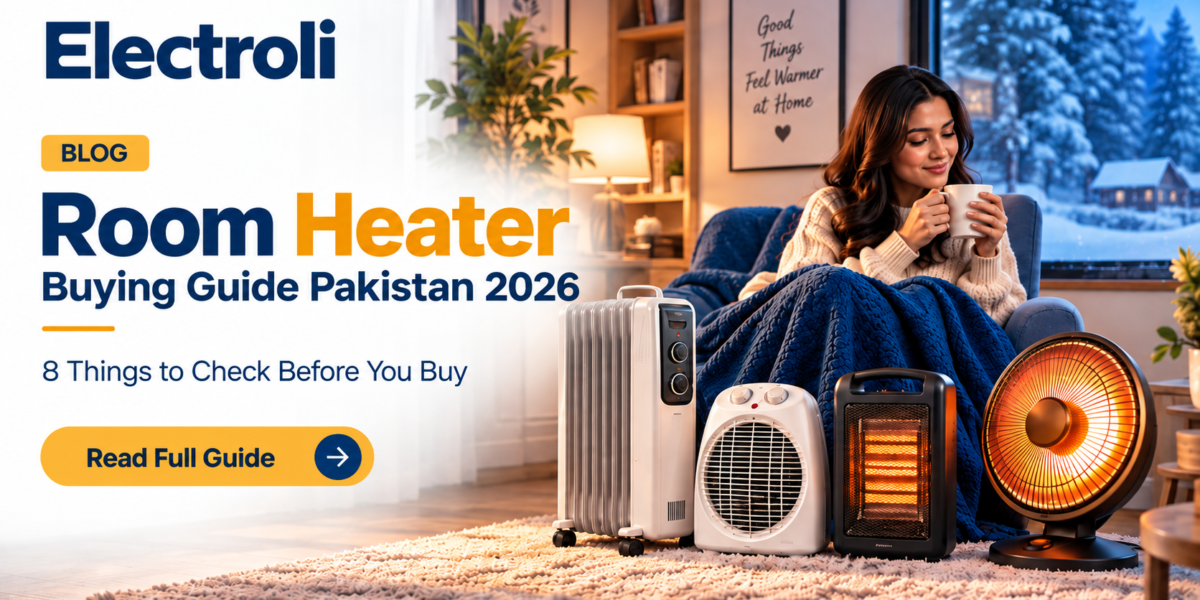
Winter Is Here But Don’t Buy a Heater Just Because It Gets Hot
When temperatures start dropping in Pakistan, a room heater can quickly move from nice to have to something you use every day.
But browsing heaters creates another problem fan heater, halogen, quartz, ceramic, oil-filled, higher wattage or lower wattage?
The heater producing the most heat is not automatically the right heater for your home.
A better buying decision starts with your room, usage, electricity concerns and safety requirements. Before buying a room heater this winter, check these eight things.
1. Start With the Room You Want to Heat
Before looking at brands, start with the room. A small bedroom, study or home office has different heating requirements from a large living room.
Consider room dimensions, ceiling height, doors and windows, drafts, insulation, how many people normally use the room, and how long you expect to run the heater.
Simply buying the highest-wattage heater available is not necessarily the most sensible approach. Match the heater’s intended use to the space.
| ELECTROLI BUYING TIP Room first. Heater second. |
2. Understand the Different Types of Room Heaters
Fan Heaters
A heating element warms the air and a fan circulates it. Fan heaters can be useful when you want quick warmth, particularly in smaller spaces.
Halogen / Quartz Heaters
These provide more direct radiant heat. Instead of primarily warming all the air in a room, they can feel especially effective when you are sitting within their heating direction.
Ceramic Heaters
Ceramic fan heaters use a ceramic heating element combined with airflow. Depending on the model, they may include thermostats, multiple power settings and safety features.
Oil-Filled Heaters
These use electrically heated oil sealed inside the radiator body. They generally warm more gradually than fan heaters but can suit situations where you want steadier warmth over a longer period.
Do not ask only: “Which heater type is best?”
Ask instead: “Which heater type fits how I want to heat my room?”
3. Check the Wattage Before Buying
You may see heaters rated at 800W, 1,000W, 1,500W, 2,000W or other power levels. Wattage tells you the appliance’s rated electrical power not whether it is automatically the best heater.
A higher-power setting can produce stronger heating but also draws more electricity while operating at that setting.
Simple Electricity Calculation
Watts ÷ 1,000 × Hours Used = kWh (electricity units)
Example: a 1,500W heater running continuously at full rated power for 2 hours would theoretically use:
1,500 ÷ 1,000 × 2 = 3 kWh = approximately 3 electricity units
For four hours at full rated power, the same calculation gives 6 kWh. Actual consumption can differ when a thermostat cycles the heating element or lower power settings are used.
To estimate cost, multiply estimated kWh by the applicable per-unit cost on your electricity bill. Avoid relying on one universal rupee-per-unit figure because tariffs and effective billed rates vary.
4. Don’t Confuse Low Wattage With Best
A lower-wattage heater can consume less electricity per hour at full power, but if it cannot adequately heat the intended space, that does not automatically make it the better purchase.
Similarly, buying a very powerful heater for a tiny space can be unnecessary. The goal is appropriate heating for the room plus sensible electricity use not simply the lowest wattage.
5. Safety Features Should Be a Priority
Room heaters produce significant heat, so safety should never be treated as an optional extra. Depending on the model, useful features can include:
Overheat protection: Helps shut the appliance down if it reaches an unsafe internal temperature.
Tip-over protection: Designed to switch certain portable heaters off if they fall over.
Thermostat: Helps regulate operation around a selected temperature.
Stable base: Especially important for portable heaters.
Appropriate plug and cable design: Check the manufacturer’s requirements and the condition/capacity of the household electrical connection.
Regardless of built-in features, always follow the manufacturer’s placement, clearance and operating instructions.
6. Think About Where You’ll Place It
Do not decide placement after purchasing. Ask beforehand where the heater will sit and whether that location is suitable.
Keep portable heaters away from combustible materials such as curtains, bedding and furniture, following the manufacturer’s required clearances. Do not position a heater where it can easily be knocked over or where children or pets can come into unsafe contact with it.
For high-power portable heaters, follow the manufacturer’s electrical instructions rather than assuming any extension lead or power strip is appropriate.
7. Look for Features You’ll Actually Use
Modern heaters may offer adjustable thermostats, multiple heat levels, fan-only mode, oscillation, timers, remote controls, digital displays, eco modes, carry handles or smart controls.
Do not pay extra just because the feature list is longer:
- If you move the heater between rooms, portability may be more valuable than Wi-Fi.
- If you use it at predictable times, a timer may matter more.
- If temperature comfort is your priority, a thermostat may be particularly useful.
| ELECTROLI BUYING TIP The right feature is the one that solves a real problem for you. |
8. Compare the Total Decision Not Just Price
Imagine Heater A is cheaper upfront but has fewer controls and is unsuitable for your intended room. Heater B costs slightly more but matches your usage and includes appropriate controls and useful safety features.
The cheaper heater is not automatically better value.
| Check | What to Consider |
| Room | Where will you use it? |
| Heater Type | Direct warmth or room-air heating? |
| Wattage | What is the rated power? |
| Controls | Can heat output or temperature be adjusted? |
| Safety | What protections does the model provide? |
| Portability | Will you move it frequently? |
| Warranty | What does the manufacturer cover? |
| Price | Does the product justify its cost for your needs? |
How Much Electricity Does a Room Heater Use?
The quickest estimate is:
Power (kW) × Running Time (hours) = Energy (kWh / units)
| Heater Rating | 1 Hour | 3 Hours | 5 Hours |
| 800W | 0.8 units | 2.4 units | 4 units |
| 1,000W | 1 unit | 3 units | 5 units |
| 1,500W | 1.5 units | 4.5 units | 7.5 units |
| 2,000W | 2 units | 6 units | 10 units |
These are illustrative calculations assuming the heater continuously draws its full rated power. Actual consumption can differ when thermostats cycle the heating element, lower power modes are used, or the appliance operates differently from its maximum rating.
Which Heater Type Might Fit Your Situation?
| Your Situation | What to Compare |
| Small room + quick warmth | Suitable compact fan or ceramic options. |
| Personal / direct warmth | Radiant quartz or halogen designs may be worth comparing. |
| Longer, steadier heating | Compare oil-filled radiator options where available. |
| Moving between rooms | Prioritize portability, dimensions and a proper carry handle. |
| Electricity-conscious buyer | Compare wattage, thermostat/control options and realistic daily running time. |
The final choice should always be based on the specifications of the exact model.
Common Room Heater Buying Mistakes
- Buying the highest-wattage model automatically.
- Ignoring room size and intended usage.
- Choosing only by purchase price.
- Ignoring safety features and placement requirements.
- Assuming ‘energy efficient’ means running time no longer matters.
- Paying for features you will not use.
- Using the heater without following its electrical and placement instructions.
ROOM → HEATER TYPE → POWER → SAFETY → FEATURES → PRICE
Frequently Asked Questions
Which room heater is suitable for winter in Pakistan?
The appropriate heater depends on your room size, desired heating style, expected running time, budget and available features. Compare these factors rather than assuming one heater type is universally best.
Does a 2,000W heater use 2 units of electricity per hour?
If it continuously draws 2,000 watts for a full hour, that equals 2 kWh, or approximately 2 electricity units. Actual consumption can be lower when thermostats cycle the heating element or lower settings are used.
Is a fan heater suitable for a bedroom?
A fan heater can provide quick heating in an appropriately sized room. Check the exact model’s specifications, noise level, safety features and manufacturer’s operating instructions before using it in your intended space.
What safety features should I check in a room heater?
Depending on the heater design, useful protections can include overheat protection, tip-over shutoff, a stable base and temperature controls. Always follow the manufacturer’s safety and placement instructions.
Should I buy the highest-wattage heater?
Not automatically. Higher wattage means greater electrical power draw at full output. Match the heater to the room and intended use rather than choosing based on wattage alone.
Final Thoughts
A room heater can make winter much more comfortable, but the right choice is not necessarily the biggest, most expensive or most powerful one.
Start with your room. Then compare heater type, wattage, safety features, controls, expected running time, warranty and price. That is how you narrow dozens of products down to the ones that actually fit your needs.
Looking for winter electronics? Explore available options on Electroli and compare products based on the features that matter to your home.
Electronics Chahiye? Electroli Se Le Lo. ⚡



 Account
 Categories

 Search
 Top
