


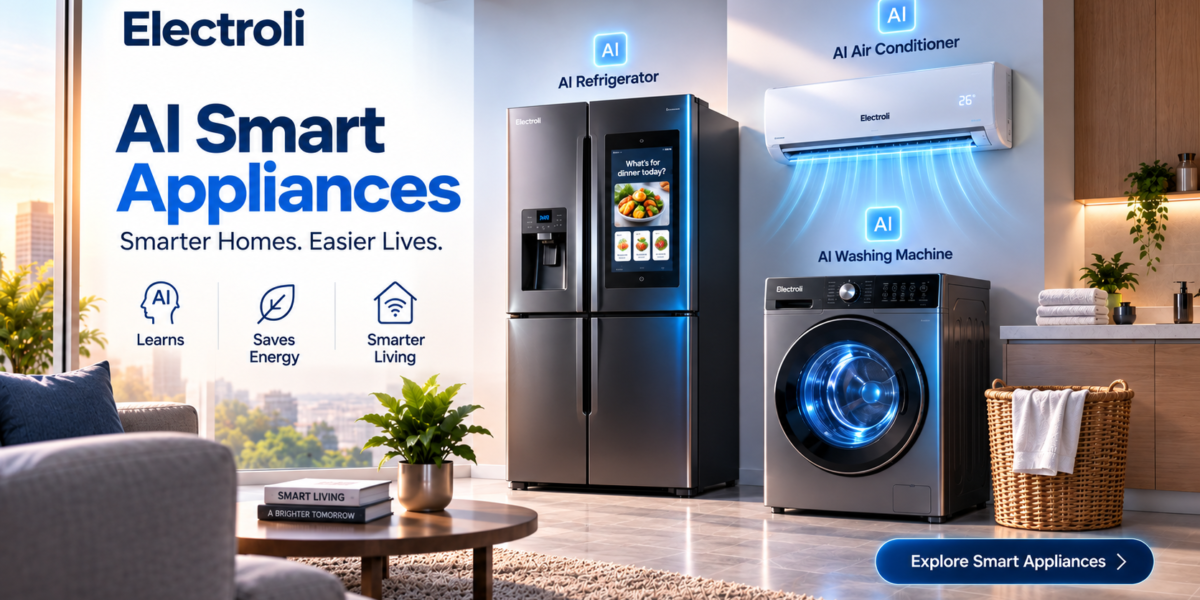
AI Is Coming to Home Appliances: What Can an AI Refrigerator, AC & Washing Machine Actually Do?
Your refrigerator recognizes food, AC learns how you prefer your room cooled, and your washing machine detects the laundry inside & adjusts the cycle.
A few years ago, these would have sounded like futuristic concepts. In 2026, manufacturers are increasingly putting AI into everyday home appliances.
Samsung’s 2026 Bespoke AI range, for example, connects refrigeration, climate control and laundry through its SmartThings ecosystem, with appliances designed to automate tasks, respond to usage patterns and help manage energy consumption.
But there is an important question consumers should ask: What does “AI” actually do inside an appliance?
An AI badge doesn’t automatically make an appliance better. Some AI functions can provide genuine convenience. Others may matter only to particular households.
Here’s what Pakistani consumers should understand before paying extra for an AI-powered appliance.
Quick Answer: What Is an AI Home Appliance?
An AI home appliance uses sensors, software and algorithms to analyze information and automatically adjust how the appliance operates.
Depending on the product, this can include: Detect → Learn → Adjust → Automate → Recommend.
| Appliance | Example AI Workflow |
| Refrigerator | Camera recognizes food → software tracks items → recipes or food-management information can be suggested. |
| Air Conditioner | Sensors analyze temperature, humidity, room conditions or presence → cooling and airflow can be adjusted. |
| Washing Machine | Sensors detect laundry weight, fabric characteristics or soil level → water, detergent and cycle settings can be optimized. |
The exact capability varies significantly by brand, model, country and connected ecosystem. “AI appliance” is a category description—not a guarantee that every AI appliance has the same intelligence.
Why Are AI Appliances Becoming a Big Technology Trend?
Older smart appliances often focused on: Phone → App → Appliance. You could switch something on, check its status or change settings remotely.
The emerging AI-home concept tries to go further: Sensors → Understand Conditions → Make Decisions → Automate Appliance.
Samsung’s 2026 Bespoke AI launch demonstrates this direction across refrigerators, air conditioning and laundry. Selected devices incorporate screens, voice interfaces, cameras, AI-based controls and SmartThings connectivity.
Remote control makes an appliance connected. AI attempts to make that connected appliance adaptive.
1. What Can an AI Refrigerator Actually Do?
A conventional refrigerator mainly needs to keep food cold. An AI refrigerator can potentially add another layer: understanding what’s happening around or inside the refrigerator.
AI Food Recognition
Some premium refrigerators now use internal cameras and computer vision. Samsung’s 2026 Family Hub refrigerator, for example, uses AI Vision to recognize supported food items as they are placed inside or removed. Its food-management system can then help users track items and use-by dates and provide recipe recommendations.
Simplified process: Camera sees food → AI identifies supported item → Food inventory updates → System can provide useful information.
Food-recognition systems still have limitations. Supported foods, accuracy and features can differ by model and market.
2. Your Refrigerator Can Help Suggest What to Cook
If a refrigerator has information about the food available, its connected software can use that context to assist with meal planning.
Instead of thinking, “Mere fridge mein kya para hai?”, the longer-term smart-kitchen idea is: “Jo ingredients available hain, un se kya bana sakta hoon?”
That’s a more meaningful application of AI than simply putting a touchscreen on a refrigerator.
3. AI Can Help Track Food Before You Forget It
Food waste often happens because something goes into the refrigerator and gets forgotten. AI-assisted food management can help track supported items and their use-by dates.
That doesn’t mean the fridge can perfectly understand every item, but it shows how AI can turn the refrigerator from purely cold storage into a form of food-management system.
4. Talking to Your Refrigerator Is Becoming More Natural
Voice control isn’t new. What is changing is the ability to understand more conversational instructions.
The goal is increasingly: Natural request → AI understands context → Appliance performs the relevant action.
What Can an AI Refrigerator Potentially Help With?
| AI Refrigerator Function | What It Can Do |
| Food Recognition | Recognize supported food items |
| Inventory Management | Help keep track of what’s inside |
| Use-by Tracking | Help users remember food dates |
| Recipe Suggestions | Recommend meals based on food/context |
| Voice Control | Handle supported appliance requests |
| Personalized Information | Show schedules, reminders or household information |
| Connected Home Control | Control compatible smart devices |
| Energy Management | Help monitor or optimize supported energy functions |
Now Let’s Talk About AI Air Conditioners
This category may ultimately be more relevant to many Pakistani households because an AC runs for hours, comfort requirements change throughout the day, and electricity consumption matters.
Traditional AC operation often looks like: User selects temperature → AC tries to maintain it. AI-powered climate control can incorporate more information.
5. AI ACs Can Analyze Room Conditions
Selected 2026 AI AC systems analyze factors including temperature, humidity and room conditions to select optimized cooling behavior.
This matters because 26°C with high humidity may not feel the same as 26°C with lower humidity. An intelligent climate-control system can potentially respond to more of the conditions that influence actual comfort.
6. AI ACs Can Learn How You Use Cooling
AI becomes more interesting when it considers patterns over time. Selected modern AI AC systems can use operating patterns and environmental information to decide between different cooling behaviors.
In practical terms, the future experience is less “Which mode should I select?” and more “The AC understands what kind of cooling is appropriate.”
7. An AI AC Can Know Where You Are
Some new systems use presence detection to direct or divert airflow. That makes AI useful for comfort rather than simply adding another app feature.
A system may offer direct cooling toward a user or indirect cooling that avoids blowing cold air directly at them.
8. AI Can Potentially Help Manage AC Energy Consumption
For Pakistan, this may be one of the most commercially important AI features.
Modern ACs already use inverter technology to regulate compressor operation. AI systems can add another decision-making layer by considering usage behavior, room conditions, temperature, humidity, occupancy, external conditions and desired comfort.
Manufacturer energy-saving claims should always be read under their stated test conditions. AI energy functions may optimize operation, but they do not guarantee a fixed electricity-bill reduction for every household.
9. Your AC May Even Respond to Your Sleep
Selected connected ecosystems can use compatible wearable information to adjust supported AC settings during sleep.
Conceptually: Wearable detects sleep state → Connected ecosystem shares relevant information → AC adjusts cooling.
This demonstrates something bigger about AI appliances: the appliance doesn’t necessarily operate alone anymore.
What Can an AI AC Potentially Do?
| AI AC Function | Potential Benefit |
| Temperature Analysis | Automatically adjusts cooling |
| Humidity Analysis | Improves comfort decisions |
| Room Analysis | Adapts cooling behavior |
| Presence Detection | Responds to where people are |
| Adaptive Airflow | Directs or avoids airflow |
| Usage Learning | Adapts to routine |
| AI Energy Management | Helps optimize operation |
| Sleep Integration | Adjusts supported settings during sleep |
| Remote Control | App-based management |
Now the Washing Machine: Where AI Can Be Surprisingly Practical
Laundry contains many variables: load weight, fabrics, soil levels, detergent requirements and water requirements. Traditionally, the user makes many of those decisions. AI washing machines are increasingly trying to make some of them automatically.
10. AI Washing Machines Can Detect the Laundry Load
Selected 2026 AI laundry systems use multiple sensors to detect load weight and use that information to determine appropriate amounts of water and detergent.
Instead of User guesses load → User selects settings, the system can increasingly operate as Machine senses load → Software analyzes it → Cycle is adjusted.
11. AI Can Identify Certain Fabric Types
Some current AI laundry systems go beyond load weight and can identify certain fabric categories under applicable load conditions.
Why does that matter? Because jeans and delicate clothing shouldn’t necessarily be treated the same way. AI can help the washing machine make more informed cycle decisions.
12. AI Can Detect How Dirty the Clothes Are
Some AI laundry systems monitor soil levels in real time and adjust the cycle. Conceptually: cleaner clothes may not need unnecessary processing, while a dirtier load can receive adjusted washing behavior.
The exact adjustment depends on the machine and selected program.
13. AI Can Help Decide Water and Detergent
Most people don’t measure every laundry load scientifically. Some AI laundry systems combine load sensing with automatic dispensing to determine more appropriate water and detergent use.
That can make AI useful in a very ordinary way: fewer decisions for the user.
14. Washing and Drying Can Communicate
Connected appliances can also share information. Some ecosystems include cycle-linking functions where related garment-care appliances coordinate recommended programs.
This reflects a broader trend: AI appliance ≠ isolated appliance. The long-term direction is Refrigerator ↔ Kitchen ↔ AC ↔ Laundry ↔ Phone ↔ Wearable.
AI Refrigerator vs AI AC vs AI Washing Machine
| Appliance | What AI Can Analyze | What It Can Potentially Adjust / Provide |
| Refrigerator | Food, inventory, user requests | Food tracking, recipes, reminders, cooling functions |
| Air Conditioner | Temperature, humidity, room conditions, presence, usage | Cooling mode, airflow, energy management |
| Washing Machine | Weight, fabric, soil level | Water, detergent, cycle settings, washing/drying |
| Connected Ecosystem | Device status + user routines | Automation and cross-device control |
Is This Really AI—or Just Automation?
Not every automatic function should be called AI.
| Type | Simple Explanation | Example |
| Automation | If X happens → Do Y | A timer switches the AC off after two hours. |
| Sensor-Based Control | Sensor detects X → Appliance adjusts Y | A washing machine detects load weight and changes water level. |
| AI-Based System | More sophisticated analysis, pattern recognition, prediction, classification or adaptive decision-making | A vision system recognizes food items or an appliance analyzes multiple inputs to determine operating behavior. |
The boundaries can become blurry because manufacturers use “AI” differently. Consumers should ask “AI karta kya hai?” rather than simply “Is mein AI hai?”
Smart Appliance vs AI Appliance: What’s the Difference?
| Smart Appliance | AI Appliance |
| Connects to Wi-Fi | May connect to Wi-Fi |
| Controlled through app | Can also analyze information |
| Sends notifications | Can potentially interpret conditions |
| Remote on/off | Can make adaptive adjustments |
| Scheduled automation | Can use sensing/pattern analysis |
| User gives command | System may automate some decisions |
An appliance can be smart without having sophisticated AI, and many AI appliances also rely heavily on smart connectivity.
Can AI Appliances Actually Save Electricity?
Potentially but don’t assume they always will. AI can help an appliance make more efficient operational decisions.
- AC: Adjust cooling based on conditions and usage.
- Refrigerator: Optimize supported cooling and energy functions.
- Washing Machine: Adjust water, detergent and cycles according to load.
Actual household energy use depends on appliance efficiency, capacity, usage hours, temperature settings, load size, room conditions, climate, user behavior and selected modes. Never buy an appliance based solely on “AI = lower bill.” Check the actual energy-efficiency specifications too.
Do AI Appliances Need Wi-Fi?
Not every AI function necessarily requires continuous internet access. Some sensing and processing may happen on the appliance itself.
However, remote control, cloud services, voice assistants, software updates, cross-device automation and certain recipe or content services may require Wi-Fi, an account or a companion app. Always check the exact model.
Can AI Appliances Improve After You Buy Them?
Connected appliances can increasingly receive software updates, which may improve or add supported software capabilities after purchase.
Update availability can vary by model and region, so buyers should not assume every appliance will receive the same features.
What About Privacy?
An AI appliance may use cameras, microphones, usage history, connected accounts, Wi-Fi, cloud services, presence sensors and household routines. That makes privacy and security part of the buying decision.
- What information does the appliance collect?
- Does processing happen locally or in the cloud?
- Which features require an account?
- Can cameras or microphones be disabled?
- How long will software and security updates be provided?
- What permissions does the companion app require?
- Can core appliance functions still be used without connectivity?
Buyers should review the privacy and security terms for the exact product and service they use.
Are AI Appliances Available in Pakistan?
Some smart and AI-assisted features already exist across appliances sold in Pakistan, but global 2026 announcements should not be treated as confirmation that every new AI model is available locally.
Features can vary by country, model, software version, language, connected service and app availability.
For Pakistani buyers: check the exact local model number not just an international review or advertisement.
7 Things to Check Before Buying an AI Appliance
1. What Does the AI Actually Do?
Ignore the badge initially. Read the feature list.
2. Does the AI Solve a Problem You Actually Have?
Food recognition may be useful for one household and unnecessary for another.
3. Does It Require Wi-Fi?
Know which functions work offline.
4. Does It Require a Subscription?
Check whether any connected or AI service has separate requirements.
5. Is the Feature Available in Pakistan?
Global feature availability doesn’t guarantee local support.
6. What Happens if the Smart Features Stop Working?
The appliance should still perform its essential job reliably.
7. Are You Paying for AI or for a Better Appliance?
First buy a good refrigerator, AC or washing machine. Then evaluate whether AI adds useful value.
Common AI Appliance Buying Mistakes
Mistake 1: Assuming Every “AI” Product Is Truly Intelligent
The term is broad. Compare the actual functions.
Mistake 2: Buying AI Instead of Core Performance
A refrigerator still needs good cooling, an AC still needs good cooling efficiency, and a washing machine still needs good washing performance.
Mistake 3: Ignoring Connectivity Requirements
Some features need Wi-Fi, accounts or apps.
Mistake 4: Assuming AI Always Saves Electricity
AI may help optimize operation, but consumption still depends on many factors.
Mistake 5: Assuming Global Features Work in Pakistan
Check the exact local variant.
Mistake 6: Ignoring Privacy
Connected appliances can collect more information than traditional appliances.
Mistake 7: Paying for Features You’ll Never Use
More technology isn’t automatically more value.
Simple AI Appliance Buying Formula
CORE APPLIANCE PERFORMANCE → ENERGY EFFICIENCY → CAPACITY / SIZE → AI FEATURE → DO I ACTUALLY NEED IT? → LOCAL FEATURE SUPPORT → PRIVACY & CONNECTIVITY → WARRANTY & SERVICE → PRICE DIFFERENCE → BUY
AI should come after the fundamentals, not before them.
So, Are AI Home Appliances Actually Useful?
They can be. The most promising AI appliance features aren’t necessarily the flashy ones. They’re features that remove small everyday decisions: a refrigerator helping manage food, an AC adapting cooling and airflow to conditions, or a washing machine automatically adjusting a cycle according to what’s inside.
Current 2026 products show manufacturers moving toward appliances that use cameras, sensors, software, voice interfaces and connected ecosystems to understand more context and automate more household tasks.
But consumers should avoid buying the letters “AI” alone. The smarter question is: Does this AI feature make this appliance more useful for my home?
FAQs
1. What is an AI home appliance?
An AI home appliance uses sensors, software and algorithms to analyze information and automatically adapt certain functions. Depending on the product, AI may recognize food, analyze room conditions, detect laundry characteristics or help optimize appliance operation.
2. What can AI do in a refrigerator?
On supported refrigerators, AI can recognize certain food items, assist with inventory and use-by-date management, suggest recipes, support conversational voice commands and integrate with compatible smart-home devices.
3. What does AI do in an air conditioner?
AI ACs can use inputs such as temperature, humidity, room conditions, usage patterns and, on some models, presence detection to adjust cooling modes and airflow. Some systems also provide AI-based energy-management features.
4. What does AI do in a washing machine?
Supported AI washing machines can detect factors such as load weight, certain fabric types and soil levels, then use that information to adjust water, detergent and cycle behavior. Features vary by model.
5. Do AI appliances save electricity?
AI can help optimize how some appliances operate, but it does not guarantee lower electricity consumption in every household. Actual energy use depends on the appliance, settings, usage patterns, environment and selected modes.
6. AI Home Appliances Price in Pakistan: What Affects the Cost?
Under it, discuss factors such as appliance category, capacity, energy efficiency, AI features, connectivity, brand, warranty and local model availability. This would add the commercial search intent without turning the informational article into a price list.
Final Thoughts
AI is moving from our phones and computers into some of the largest appliances in our homes.
The most useful future isn’t necessarily “Everything has AI.” It’s “AI handles the small decisions we shouldn’t have to think about.”
For Pakistani buyers, the priority should remain: Performance → Energy Efficiency → Capacity → Reliability → Warranty → Useful AI not the other way around.
When comparing AI refrigerators, ACs or washing machines, always verify the exact model and locally supported features before purchasing.
Looking for Smarter Home Appliances?
Compare refrigerators, air conditioners, washing machines and other electronics on Electroli according to the features that actually matter for your household.
Electronics Chahiye? Electroli Se Le Lo.




 Account
 Categories

 Search
 Top
